
-

Should You Do a No-Buy Year in 2026? ...
Every year, social media decides we’re all becoming new people. I’ve been seeing more and more people say they’re committing to a no-buy year, posting detailed “ins and outs” lists, and declaring they’re done with impulse spending, overconsumption, and excessive online shopping. For students and new grads navigating high cost of living, student debt, and uncertain job markets, the idea of pressing pause on spending can feel less like a trend and more like relief. A no-buy year doesn’t have to be so extreme, rigid, or punishing to be effective. At its best, it’s a way to slow down, reflect on habits, and make your money work harder for you, without guilt or burnout. Why no-buy years blow up every January -

Should You Post on LinkedIn Or Just ...
If you’re on LinkedIn (which you probably are), you’ve probably seen others post and wondered if you should be too. Career advice always says you should be “building your personal brand,” recruiters talk about visibility, and your feed is full of people announcing new roles, sharing big lessons, or posting long reflections that somehow say a lot without saying much at all. It can make LinkedIn feel less like a professional network and more like a performance. All to say, this made me question if posting on LinkedIn actually matters or if it’s really just for show.Why posting on LinkedIn feels so awkward A lot of LinkedIn posts feel -

What “Flexibility” Really Means in a ...
As a student or new grad, you’re juggling more than most people realize. You’re figuring out your career path, adjusting to full-time work that likely has no end date, managing your social life, dealing with financial pressure, and maybe even navigating a move or continuing classes. That’s why the idea of flexibility means something different for young professionals. It’s not just a buzzword or a perk – it can be the difference between feeling supported and feeling overwhelmed. Even though flexibility is something people at every stage of their career appreciate, it has a special kind of impact early on. When you’re still discovering your strengths, learning how you work best, and building habits that will shape your career for years to come, having a little breathing room makes a huge difference. What flexibility actually looks like day-to-day -

Skills-Based Hiring Explained: What ...
If you’re graduating soon (or recently entered the workforce), you may have also seen headlines about the rise of skills-based hiring, where employers are focusing more on what candidates can do rather than just what their resume says in terms of education and experience. With so much discussion online, it’s easy to question whether formal education still matters or if hiring expectations are changing entirely. Before panic sets in, I’m here to tell you that degrees continue to play an important role, especially for entry-level candidates who are still building professional experience. What’s changing (in some cases, certainly not all) is how employers assess readiness for work. Instead of viewing education as the only measure of potential, many companies are looking for a combination of academic knowledge and demonstrated skills. Understanding this shift can help you feel more confident (and more prepared) as you transition from student to employee. Education and experien -

Workplace Trends You Can’t Ignore in ...
If you’re about to start your first job or you’re early in your career like me, one thing you’ll notice right away is that the workplace is always changing. It’s constantly evolving, not just in tech, but also in how we work, what skills matter and what companies are expecting from new people coming in. I’ve been really tuned into the trends people are anticipating this year and thought I’d pull together the biggest and most relevant ones, and share what they might mean for you, your career and how you show up in the job market. Humans still matter (especially with AI everywhere) At some point in the last year or so you&r -

Waiting for Grades Is Worse Than Fin ...
I know the feeling all too well – final exams are done, your laptop is closed, your notes are packed away (or thrown out, to each their own), and the deadlines that took over your life for months are finally gone. So why does it feel like you still can’t fully relax? For a lot of students, the period after exams, especially at the end of a full semester, brings a different kind of stress. Waiting for grades can feel more unsettling than the exams themselves. There’s nothing left to study for, nothing you can change, and usually no clear timeline for when you’ll finally know where you stand. Essentially, if that anxious, in-between feeling where you’re checking your student portal every half hour sounds or feels familiar, you’re not alone. -

More Young Canadians Are Juggling Mu ...
I feel like almost all of my friends are working more than one job right now, which feels crazy because we all have good, full-time jobs. Recently, I came across a report that shows Canada actually leads the world in “poly-employment”, which is basically a fancy word for having more than one job at the same time – so that checks out. Between rent, tuition and/or paying back student loans, groceries that somehow cost $50 even though you bought two things, and trying to build savings, a single job doesn’t always cut it anymore (unfortunately). -

How to Turn Your School Projects int ...
Let’s be real – landing your first job can feel like a full-time job in itself. When it comes to landing your first job, especially within creative industries, your resume and cover letter are (unfortunately) just the beginning. More and more employers want to see a tangible example of your work – a portfolio that shows off your skills, thought process, and creativity. This sounds scary until you realize you’ve probably already done a lot of the work during your time in school. All of the presentations, essays, research or group projects can actually shine in a portfolio with just a little tweaking. Here’s how:1. Find Your Standout Projects -

Corporate Gaslighting Is Real, You’r ...
I was listening to a podcast recently where the host was talking about workplace culture, specifically the subtle ways some employers make people feel like they should be grateful just to be employed. I haven’t personally experienced this in a severe way, but I know many who have, and the stories all sound similar.People talk about being told things like “in this economy, you’re lucky to have a job” or “a lot of people would love your role, you should be grateful.” On the surface, these sound like reality checks but they can actually make people feel small or unworthy, which isn’t just tough feedback, it’s corporate gaslighting. The gratitude trap -

Gen Z and the Shifting Job Market: M ...
After my first year in the professional world, and having many friends who are either still students or job seeking, I’ve realized the job market isn’t what it used to be. The classic cycle of “apply, wait, interview” isn’t cutting it anymore – it can feel slow, frustrating, and sometimes like you’re going nowhere. The Job Market Has ChangedSeveral factors have contributed to a changing landscape. The rise of remote work has expanded opportunities but also competition, while automation and AI are reshaping roles faster than ever. Employers are increasingly looking for adaptability, creativity, and self-starters – qualities that go beyond what a traditional job application can showcase. -

The Great Lock-In: Should You Join I ...
Every September feels like a reset. Our routines finally pick back up after a hectic summer, and suddenly there’s a collective sense of wanting to get our lives together. This year, that energy has taken shape as a social media trend called The Great Lock-In, and it’s quickly becoming the internet’s favourite way to say you’ll “lock in” on goals before the year ends.The Lock-In runs from September through December, where people commit to strict routines, self-improvement challenges, and ambitious goals. It’s basically New Year’s resolutions, but -

How to Talk About AI Skills on Your ...
If you’ve started job searching recently, you’ve probably noticed employers asking for AI skills or AI fluency. But what does that even mean? For some reason although AI is widely adopted in many workplaces today it still feels controversial to put it on your resume or brag about your experience with it. Many job postings include AI as a buzzword without clearly defining what skills they’re looking for. And that can leave students and new grads wondering how (or if) they should add AI to their resumes at all. AI Isn’t Cheating, It’s Learning Obviously, employers aren’t looking for you to say “I copy-paste my assignm -

What Ontario's 2026 Job Posting Requ ...
If you’ve ever felt like your job applications were disappearing into a black hole, you’re not alone. The struggle of applying to countless positions and dealing with radio silence is so real. But the good news is that starting January 1, 2026, Ontario is implementing new job posting requirements in hopes of making the hiring process more transparent, fair, and therefore student friendly. What’s Changing? -

Knowing When You've Got It Good (and ...
Starting your career, or even your first real job (or big girl job as I like to call it) after graduation, is an exciting, sometimes overwhelming experience. For many students and new grads, it’s easy to fall into one of two traps: romanticizing the idea of a “dream job” or constantly wondering if the grass is greener elsewhere. Both mindsets can lead to frustration, indecision, and even burnout. Learning how to critically assess your job experience can help you make smarter, more confident career decisions. Here are some tips: 1. Understand What “Good” Really Looks LikeA “good” job doesn’t always mean the one with the flashi -

From Dream Job to Game Plan: Explore ...
Whether you’re planning your next steps after high school, deciding what to study in college or university, or thinking about a career change, making the right choice can feel overwhelming.Campus Connect’s new Labour Market Information (LMI) Tool is an AI-driven tool built with an intuitive user interface. It’s here to help you make smarter, more confident decisions about your education and career path. The tool uses vetted Canadian data to ensure the insights provided are relevant, accurate and reflective of the current national job market. -

The Power of the To-Do List: Why You ...
To-do lists have been around forever, and for good reason. Believe me, I don’t think I’m reinventing the wheel here, I just think it’s interesting to understand more about why they are so helpful. No matter what you call them – plans, priorities, goals, or reminders, there’s something so satisfying about writing things down and crossing them off once you’re done. It’s one of the simplest yet most effective ways to stay organized and on track. There’s actually some interesting psychology behind the satisfying feeling. Research shows that our brains crave order and closure. According to an -

Is your career your whole identity?; ...
As a new grad, I can almost guarantee one of the questions you both ask and answer is something along the lines of “what do you do for work?” It’s a simple question, but it carries weight (and can bring up a lot of emotions for those that don’t have something lined up quite yet.) The way we answer can shape how others perceive us, and how we perceive ourselves. But should it? Is our career truly reflective of who we are? Why we often tie our identity to work In a world that often equates success, it’s pretty easy to see why so many people tie their identity to their career. It makes sense especially when I look back on the internship search when I was in university, and there were a few people who were only interested in working at the massive companies like KPMG, Microsoft, Google, Dyson, etc. -

Why It's Okay If You Don't Have a Su ...
This is the time of year when stress on university and college campuses is at its peak (tis the season, am I right?). Of course, there’s all the normal pressure from classes and studying for midterms, but there’s an added pressure from hearing about where everyone is interning and what everyone is doing over the summer. For so many people, and I’ve experienced this too – it’s stressful for those who don’t have an opportunity lined up for the summer. The PressureThe pressure to have a summer internship lined up can feel overwhelming, especially when it seems like everyone around you is making major strides in their professional development. It's natural to question your own progress and wonder if you're falling behind. Remember that success is not a race, and each opportunity will come with time. Trust in Your PathWhile it may feel disheartening and discouraging to see your peers landing impressive internships or jobs that you applied for too, it's essential to trust in your own path. The right opportunity will come along when the time is right. Use this period to explore different options, network with professionals in your field of interest, and continue to enhance your skills and knowledge.It Takes Time to Build Experience -

Why Time with Friends is Important f ...
As students and new grads, we often find ourselves juggling multiple responsibilities. These can and will look different for everyone but can include academic pressure, job search stress, working, extracurriculars, and financial challenges. So, for some people, it can be easy to neglect our social lives and underestimate the value of spending time with friends. However, maintaining strong connections with friends is important for our mental well-being, all the time, but especially during this stage of life.Dealing with Isolation and LonelinessOne of the most significant issues that students and new grads face is the feeling of isolation. Some of us might live away from home, deal with demanding academic or work schedules, and experience the pressures of transitioning to a new phase of life, all of which can contribute to a sense of loneliness. This is where friends play an important role, and why I think we should all be thankful for them. Spending time with them helps us combat some isolation we might feel and establish a support system, giving us a sense of belonging and reducing some feelings of loneliness.Stress Relief and Emotional SupportThe challenges of academic life, job search, and financial constraints can take a toll on our mental health. Spending time with friends acts as a powerful stress reliever and provides emotional support during times of distress. Whether it's a casual hangout, a laughter-filled movie night, or a heart-to-heart conversation, the presence of friends can help alleviate anxiety and provide a safe space for sharing and relating to our struggles.</ -

Coaches vs. Mentors: Key Insights fo ...
Being a college/university student or new grad means embarking on a path full of growth opportunities and challenges. Throughout this, you may inevitably come across the words "coaching" and "mentoring." While these two concepts can sometimes be used interchangeably, they actually serve different purposes and offer unique benefits. Let's take a look at the key differences between a mentor and a coach to help you navigate both your academic and professional endeavors effectively.Understanding CoachingWhat is Coaching?Coaching is a personalized and dynamic process focusing on helping individuals maximize their personal and professional potential. Unlike a mentor, a coach does not provide direct solutions or advice. Instead, they act as “thinking partners”, guiding you to find your own answers through thought-provoking conversations and self-reflection.How Can Coaching Benefit You as a Student/New Grad?As a student/new grad, coaching can help you enhance your personal development, improve study skills, set and achieve academic/professional goals, and boost your overall performance. A coach can support you in areas such as time management, stress management, decision-making, and building resilience, ultimately empowering you to reach your full potential (who doesn’t want that?!)Understanding Mentoring -

Your Reference May Be Outdated - Her ...
As a student, new graduate, or entry-level professional, strong references are often an important step in your job search journey. However, it's essential to recognize when a reference may be outdated and when it's time to consider selecting a more recent alternative. Here are a few key indicators and considerations to help you make that decision: 1. Passing Time/Industry Knowledge and RelevanceGenerally speaking, references, just like any information, have a shelf life. As a general guideline, references older than five years may start to lose their impact, especially in industries where technology and best practices evolve rapidly. When considering the relevance of a reference, think about how much has changed in your field since that individual was familiar with your work.2. Professional Relationship and CommunicationAssess the nature of your professional relationship with the individual serving as your reference. If you haven't worked with or communicated with them for an extended period, their ability to speak to your current skills, accomplishments, and work ethic may be limited. A reference who is disconnected from your recent achievements may not be the best advocate for your candidacy. For example, if you’re about to graduate university, a high school teacher or coach isn’t necessarily the best person to speak to your current accomplishments. Note: Avoid using your family, friends, or previous managers from jobs where you didn’t leave on a positive note. Including these people makes for some awkward c -

A Closer Look at Gen Z’s Stance on t ...
In a recent survey conducted by Development Beyond Learning, it was revealed that Gen Z workers perceive a four-day work week as a solution that could significantly enhance the appeal of jobs. The survey findings showed that 93% of Gen Z respondents welcomed the idea of a condensed work week, emphasizing the crucial role it plays in achieving work-life balance and promoting mental well-being. As of this year, Gen Z will make up approximately 30% of the global workforce, so our opinion is starting to have some leverage. Gen Z’s view: Mental health, productivity, and flexibilityThe overwhelming positivity towards a four-day work week among Gen Z individuals shows their deep-rooted value for work-life balance. This generation places a high premium on personal time, leisure activities, and mental health, recognizing the importance of finding balance between professional commitments and personal well-being.Back to the survey - 90% of respondents believe a four-day work week would improve their mental health. When asked to outline their plans for the additional day off, the focus was predominantly on personal well-being:31% would prioritize rest and self-care;27% would explore hobbies or -

Saying Goodbye to Hustle Culture and ...
Lately, we've seen a shift in how we think about work and success. Hustle culture, with its emphasis on constant productivity and working no matter what, is being overshadowed by a new trend (although I hope it’s not a short-lived trend at all), that's all about prioritizing well-being and balance. This shift is important for Gen Z, as it signifies a move away from the traditional idea of success and towards a more realistic approach to work. The Rise and Fall of Hustle CultureHustle culture, aka the celebration of overworking and glorified busy lifestyles, reached its peak in the 2010s. Influencers and entrepreneurs proudly shared their never-ending work and lack of sleep as signs of success, promoting the belief that sacrificing everything for work was the only way to make it. Studies showed that burnout was common among workers, with many feeling exhausted and unhappy with their work-life balance. The COVID-19 pandemic made these issues even more apparent, as remote work blurred the lines between professional and personal life, leading to record levels of exhaustion. Economic challenges, such as student loan debt and unaffordable housing, have also contributed to the younger generation moving away from hustle culture altogether. The Shift to Well-being -

Exciting Career Paths for Students a ...
I recently came across an article that shared salary forecasts for 2025, and wanted to share some insights with all of you. As students and new grads navigate the job market, it's important to be aware of the industries and fields that are expecting significant pay increases in Canada in 2025, and with that, which ones aren’t. With the evolving economic landscape, certain sectors are projected to offer lucrative opportunities for those starting their careers (that’s us!). Let's dive into some key insights - industries and areas of interest for students and new grads seeking promising career paths.1. Skilled Trades, Technology, and Engineering:The demand for skilled workers in industries such as technology and engineering continues to grow. Automation technicians and electromechanical workers are expected to experience an 8% pay increase, making these fields very rewarding for new graduates looking to enter the workforce.2. -

5 Effective Study Habits for Visual ...
When you’re studying, do you find it easier to retain information through flashcards, colourful sticky notes, or videos, rather than listening to the lesson recordings or reading the textbook? Chances are, you are a visual learner. Visual learners thrive when information is presented in a visual format (of course), making use of images, diagrams and other visual aids to enhance their learning experience. If you identify as a visual learner, here are five effective techniques to consider while studying: Use Visual Aids Visual aids such as charts, diagrams, and illustrations can help reinforce concepts and make them easier to remember. When studying, try to create visual representations of the information you are trying to learn and remember. This could mean charts, graphs, or timelines that visually organize key points and relationships. Embrace Colour Coding Colour coding can be a powerful tool for visual learners to categorize and remember information more effectively. Highlighters or coloured pens can be particularly useful - you can assign different colours to different topics, themes, or types of information in your notes. For example, -

How To Handle an Interviewer No-Show ...
First, I want to say: I’m so sorry your interviewer didn’t show up. Any frustration you feel is 100% valid.When interviewing for a job, you want to make a good first impression. This may mean reviewing common interview questions and making sure you arrive early or at the very least, on time. But even when you do everything right, there might still be times when your interview doesn't go quite as planned - like when the interviewer doesn't show up for your meeting. Here are some tips for navigating a situation like this: Respond Proactively and Confirm the No-ShowBefore taking any action, ensure that the interviewer has indeed missed the meeting. Contact your interviewer (or the recruiter who scheduled it) 5-10 minutes after your designated start time. A quick no-blame message will allow you to confirm whether there’s been a misunderstanding or something unexpected that led to the absence. The company's HR department or the person who arranged the interview to confirm whether there has been a misunderstanding or an unexpected occurrence that led to the interviewer's absence.“I am checking in to make sure you’re still available for our 2pm ET interview today. I hope everything is okay on your end and if you need to reschedule, let me know a few alternative windows that work for you this week. Thanks so much! ”Or if you’re emailing a recruiter: -

No more guilt trips: Why you shouldn ...
As an entry-level employee, one of the perks you look forward to is the allocated (and paid) time off work, whether it’s for a long-awaited trip, a staycation, or simply a well-deserved break. However, many Canadians find themselves burdened by feelings of guilt when it comes to utilizing their vacation days, to the extent that they end up working during their time off or, worse still, taking less time off altogether.A recent survey found that 35% of respondents felt as though they were still expected to work during their vacation, further adding to the guilt they experienced if they chose not to. In addition, the same survey showed that 37% of the Canadian participants are taking less vacation time, while 20% reported not taking time off at all.I think these statistics highlight a major issue in the workplace. Which leads me to reminding everyone, but especially entry-level employees, that you shouldn’t feel hesitant to take the time off you’re entitled to. Let’s look at some reasons why: It’s a part of your compensation I want to remind you that your vacation time is a part of your compensation package. Just like your salary and benefits, vacation days are an important component of the overall package of compensation that you receive for your work. It is important to -

How to Reach Out to Past Connections ...
With the job market being so competitive, networking becomes more and more important to landing your dream job, and one of the most effective ways to leverage your network is by reaching out to past connections for job leads. These connections, whether former colleagues, classmates or acquaintances, can provide valuable insights, referrals and opportunities that may not be easily accessible through “traditional’ job search methods. Now, I know what you’re thinking - what if I only met this person once? What if I haven’t nurtured the relationship as much as I should’ve? Despite some initial hesitation and awkwardness, you should know that leveraging these ‘one-off’ connections can be incredibly beneficial in your job search (to be honest, the worst thing they can do is not respond, or say no. And in that case, at least you tried). Let’s look at how you can effectively reach out to past connections for job leads, whether they were once close to you or individuals you’ve only met briefly at a networking event. Steps to Reach Out to Past Connections for Job Leads:Identify Your Target Connections: Make a list of past connections who may be able to assist you in your job search. This could include previous coworkers, supervisors, classmates, or individuals you've met at networking events.Craft a Personalized Message: When reaching out to past connections, personalize your message to make it more impactful. Mention how you met the person, express your interest in their work, a -

The Hidden Job Market: Advice on Tap ...
Did you know that around 70% of job openings aren’t publicly advertised? Research also suggests an even larger percentage of jobs are often filled through personal and professional contacts. We all knew the job market has been tough, but this really emphasizes the importance of doing more than just the click-and-apply approach. Before I started my internship, one of my interviews was for a job that wasn’t even posted! Because of that, I feel ready to share some things you should know when tapping into unadvertised opportunities: Not all jobs are advertised so networking is importantI know you know this, but felt like I wanted to elaborate. Some companies rely heavily on referrals from people they know and their own employees, and some rely heavily on hiring internally. This is where networking becomes really important.This can mean starting to let family and friends know that you’re interested in getting a job and the kinds that you’re interested in. This might mean leveraging LinkedIn to network with strangers who have jobs you might be interested in. Either way, in order for people to know you’re looking for a job and interested in learning more, you have to put it out there. Once you make some genuine connections, it’ll be a lot easier to rely on those (and hopefully you can get a referral from it, or they can send your resume to the right person)! Professional associations have a lot of industry resourcesProf -

How to Ask for a Letter of Recommend ...
When you apply for admission to a university or college, a job, or a scholarship, you may be asked to include letter(s) of recommendation. These letters, usually written by teachers, mentors, or managers, are meant to vouch for your qualifications and character. This means its always a good idea to keep a running list of go-tos you can reach out to when you need. A strong recommendation allows the person reviewing your application to get to know you beyond your resume, painting a more complete picture of who you are and how you’re motivated. I know the process of asking for a letter of recommendation (especially over email) can seem daunting. In this blog post, I’ll walk you through some steps so you can feel better about asking for one. How to request a letter of recommendationFirst of all, It’s totally normal to feel nervous about asking for a letter of recommendation. While it may feel uncomfortable at first, it’s a normal part of many application processes. Step 1: Identify the right recommender When selecting someone to write your recommendation letter, it’s important to choose someone who knows you well and can speak to your strengths, skills and personal qualities. These are often people like professors, mentors, supervisors, or colleagues who have worked closely with you and can provide detailed insights on you as a person and how you work. -

Should you really negotiate your sal ...
Navigating the job market as an entry-level applicant can be both exciting and nerve-wracking. Take it from me, I literally just did it. From experience, I know that when it comes to job offers, many entry-level applicants wonder if they should just accept the first salary offer presented to them, or if they should really attempt to negotiate their salary. While it may seem daunting, salary negotiation is an important step that can have an impact on both your career trajectory, and your financial well-being (obviously). Here’s what you should know: Know your worth Before entering into salary negotiations, take the time to research and understand your market value. Websites like Glassdoor can provide valuable insights into what others in similar roles are earning. By knowing your market value, you can make a more informed decision when it comes to negotiating your own salary. Set Realistic ExpectationsWhile aiming high is important, it's also good to set realistic expectations for your negotiation. You should consider factors such as the cost of living in your area, industry norms, and the other benefits being offered by the employer.Highlight Your ValueDuring the negotiation process, you should showca -

What to Do When Your Job Requires Yo ...
As a student or new grad entering the job market, you might find yourself faced with the challenge of needing to be proficient in public speaking for your job. Whether it's presenting to clients, speaking at conferences, or leading meetings, being able to communicate effectively in front of an audience is a valuable skill that can greatly impact your success in the workplace. I know what you’re thinking… I haven’t quite nailed it yet. Truthfully, me either. But, if the thought of public speaking makes you nervous, I’m here to say don't worry! I have a few strategies and tips to help you become a confident and skilled public speaker for when it counts the most. 1. Embrace the Opportunity to Learn and GrowPublic speaking is a skill that can be developed and improved with practice. Instead of seeing it as a scary requirement, think of it as an opportunity to enhance your communication abilities and grow both personally and professionally. Put it this way, if your manager asked you to present, they are confident enough in your ability to be successful. So, take it as a compliment. By adopting a positive mindset, you can approach public speaking as a valuable skill that will set you apart in your career.2. Seek Out Opportunities to PracticeLook for opportunities to practice public speaking in different settings. This could include hoping on a fake Zoom call with your friends, volunteering to give presentations in class, or taking on leadership roles in student groups. The more you expose yourself to speak -

How to Seek Mental Health Support/Re ...
Being a student can be an exciting and rewarding experience, but it can also come with its fair share of challenges and stress (with 20 years of experience as a student, I can confirm this is true). Taking care of your mental health is crucial, and fortunately, Canadian colleges and universities offer various resources and support systems to help students cope with mental health concerns and challenges. In this blog, we will explore how you can seek mental health support as a student, along with highlighting specific resources provided by Canadian educational institutions.See also: Student Self-Care Advice From Psychotherapist Victoria EmanuelSee also: Self-Care Isn't Selfish1. Recognize the Need for SupportThe first step towards seeking mental health support is recognizing that you may need it. I want to remind you that it's okay to ask for help. It takes a lot of strength to reach out and prioritize your well-being. Whether you are feeling overwhelmed, anxious, stressed, or experiencing a mental health condition, there are resources available to assist you.2. Explore Your Campus Resources -
Does Networking Really Work?
To answer this quickly, YES. And, according to HubSpot, 85% of jobs are filled through networking.But, similar to just about everything else, the results very much depend on the effort you put it. Build those relationshipsAs someone who just started taking networking seriously this year, I can confidently confirm that networking makes a difference. It has opened doors for me, mostly leading to job interviews for positions that were never even posted. Networking goes beyond merely connecting with others for job opportunities. It is about building meaningful relationships in your industry, meeting mentors, and gaining insights from experienced professionals. Through networking, I have been able to tap into so much knowledge and expertise that has significantly contributed to my personal and professional growth.Networking isn’t the only answerNetworking isn’t the only pathway to success. I recently secured a new job without relying on networking connections. This experience reminded me that while networking can be powerful and provide great opportunities, it is not the be-all and end-all of job searching. While networking may not have directly led me to securing this specific job, it has been an essential part of my personal journey. Through networking, I have had the privilege of meet -
How to Stand Out in Situational Inte ...
Are you preparing for a job interview and feeling a bit overwhelmed by the thought of facing situational interview questions? Don't worry, you're not alone. Many candidates find these types of questions challenging they require you to demonstrate your problem-solving skills and showcase your ability to handle various scenarios. However, with the right insights and preparation, you can approach situational interviews questions with confidence and increase your chances of success.In this blog, we will explore five key takeaways from the article, 5 Ways to Prepare for Situational Interview Questions from Harvard Business Review. These insights will help you understand how to anticipate and respond to these questions effectively!Use a proven format: The STAR(T) (Situation, Task, Action, Result, Takeaways) or CARL (Context, Action, Result, Learning) method provides a structured framework for answering situational interview questions. By following this format, you can make sure you provide the necessary information in a concise and organized manner. For example, when discussing a problem you solved, start by providing context about the situation, explain the task or goal, describe the actions you took to address the problem, discuss the results of your actions, and reflect on the key takeaways or lessons learned.Focus on alignment: It’s important to demonstrate how your past experiences align with the requirements of the job -
Entry Level Job Descriptions 101: Ho ...
Let’s be honest - the job market is competitive these days. Understanding how to read an entry level job description is a critical skill that can (maybe) make or break your chances of landing the job. By breaking down the various components of a job description, conducting thorough research, and crafting a tailored application, you can increase your chances of capturing the attention of recruiters.We spoke to Charlotte Marvin, Human Resources Manager at Total Credit Recovery Limited, about the right way to read an entry level job description, and she shared some valuable tips. [Please note the views and opinions expressed below are specific and individual to Charlotte, and not that of TCR.] “Paying attention to the bulleted “requirements” of jobs is key - this is how recruiters will often decide what resumes to pre-screen, and which to reject without contact. If you don’t meet the minimum requirements for items such as location, working hours and availability, etc, its not worth a recruiters’ time to call you, when we know it doesn’t align right off the hop or if there will be a large barrier to getting you employed.” “When it comes to entry level jobs, a lot of applicants are either fresh out of school, new to the country, or experiencing a career change- or all 3 cases may apply to one applicant. For this reason, I’m a big fan of cover letters, especially when you have no work experience, or no relevant experience on your resume relating to the role you apply for.” -
20 Skills New Grads Should Have on T ...
As a fresh grad, crafting an impactful resume with relevant skills can be challenging (believe me, I know). Recruiters are looking for specific skills and experiences that make you stand out from the competition. Let’s chat about the top 20 skills that every new grad should consider including on their resume:Communication: Strong written and verbal communication skills are essential for any job. Highlight experience with public speaking, writing, and collaborating with othersTime Management: Show that you can handle multiple tasks effectively by including examples of how you prioritized and organized your workload during internships or academic projects.Adaptability: Demonstrate your ability to adapt to new environments and work well under pressure by showcasing real-world examples where you effectively handled unexpected challenges. All of us were students during the pandemic - if that doesn’t scream adaptable, I don’t know what does. Leadership: Even if you haven't held leadership positions, highlight teamwork and leadership experiences, such as projects or mentoring roles in school. Problem-Solving: Employers value analytical skills. Include instances where you identified and solved problems, implemented innovative solutions, or contributed to process improvements.< -

Five Workforce Trends to Watch This ...
As we approach 2024, it's important to stay ahead of the curve and understand the trends that will shape the modern workplace. ??Recently, I came across an insightful Forbes article by Dr. Samantha Madhosingh, sharing the key trends shaping the future of work in 2024. Let’s take a look at the trends and how they might impact the jobs we have and land this year: Embracing the Return to OfficeAs we know, a big trend is returning to the office. Many companies are moving towards a hybrid model, blending both in-office and remote work. While remote work became popular during the pandemic, studies have shown that many employees crave the structure and interaction of working in the office. However, the flexibility of remote work arrangements is also highly valued by employees. As we enter 2024, businesses will need to balance in-office and remote work that works for their teams and employees. Fun Fact: Some analysts suggest that we may see a full return to in-office work by 2026, but for now the hybrid model is likely to remain in effect. Increased Salary Transparency -

How to Capitalize on This January Hi ...
No! You did NOT miss it. The window for hiring continues into the new year as recruitment rarely, if ever, completely closes its cycle by year-end.January, in particular, stands out as a pivotal month in the hiring landscape. In this blog post, we'll explore the unique opportunities that the New Year hiring season presents for job seekers and provide actionable strategies to help you make the most of this promising time. Leverage New Year's Resolutions: Align Career GoalsAs individuals across the globe set new goals and resolutions for the year ahead, hiring managers and companies also reflect on their staffing needs or work to fulfill staffing needs not met in December. January is an opportune time for you to align career goals with the evolving needs of the job market. Review and update your career objectives, ensuring they align with industry trends and the skills in demand. Craft a compelling narrative around your aspirations and be ready to articulate them in interviews and on your resume. The hiring window is not yet closed for 2023 and many new roles open in 2024 - stay fixed on your goals.Refresh Your Professional Brand: Polish Your ImageThe start of a new year is an excellent occasion to refresh your professional brand. Update your resume, ensuring it highlights your recent achievements and any new skills acquired. Take the time to polish your LinkedIn profile, adding a professional photo and refining your summary. Showcase your accomplishments and contributions from the previous year, demonstrating to potential employers that you are a candidate worth considering.Tap into Budget Allocations: Early-Year Hiring Initiatives -

Mastering the Art of Salary Negotiat ...
As a student entering the workforce, the prospect of negotiating your salary can be both exhilarating and daunting. While the thought of securing a well-deserved compensation package is exciting, many find the negotiation process intimidating. However, mastering the art of salary negotiations is a crucial skill that can significantly impact your financial future. In this blog post, we'll explore three tips to help students excel at salary negotiations. Research and Know Your Worth: One of the most common mistakes individuals make during salary negotiations is undervaluing their skills and qualifications. Before entering into negotiations, take the time to research industry standards, company salary ranges, and the average compensation for similar roles in your location. Websites like Glassdoor, Payscale, and LinkedIn can provide valuable insights into salary expectations. Compile a list of your accomplishments, skills, and any relevant experience that adds value to the role. This will serve as a foundation for your negotiation, allowing you to articulate why you deserve the salary you're requesting. Confidence in your abilities and a clear understanding of your market value will strengthen your position at the negotiating table. Practice Effective Communication: Effective communication is key to successful salary negotiations. Practice articulating your achievements, skills, and reasons for deserving a higher salary. Be prepared to discuss specific examples of how you have ad -

Resilience in Rejection: A Recruiter ...
Believe me, I know that job rejection can be disheartening and demotivating. However, it's important to remember that it isn’t always about your qualifications or abilities. Sometimes, a lack of connection with the employer can be the decisive factor. In this blog, we will explore the insights and advice shared by Ali Gharaei, a recruiter from Reichmann International Development Corporation, an employer hiring on OCC right now, on how to bounce back from job rejection and find the right fit for your career. According to Ali, "No matter how perfect of a candidate you are, sometimes being able to connect with an employer is purely the reason another candidate will get the job over you. Don’t let a rejection bring you down, you just have to find the right fit for you where your personality and skills will be appreciated and in return will bring a more enjoyable experience for you in your career as well." This advice highlights the importance of interpersonal skills and building a connection with potential employers. While it is easy to feel discouraged after facing rejection, he reminds us that it is not always a reflection of our abilities or qualifications. Don't take it personally It's easy to feel frustrated or question your abilities after facing rejection. However, it's essential to remember that sometimes it comes down to factors beyond your control. It doesn't mean you are not good enough, but rather that there was a better fit for the specific position. Don't let rejection bring you down; instead, s -

What to Consider Before Using AI for ...
It’s no secret that Artificial Intelligence (AI) is becoming integrated into various sectors of our lives, including the job application process. Many companies are using AI tools to streamline the recruitment process and identify the most suitable candidates. However, while using AI tools like ChatGPT can be beneficial to refine your resume and cover letter, it’s important to consider best practices when applying to jobs to increase your chance of success. What do recruiters think?After doing some research, it seems that recruiters’ opinions on candidates using AI vary. Some acknowledge the benefits of using AI tools to enhance job applications, and some disagree. According to a 2023 insights report by HR software company iCIMS, 39% of HR professionals say a candidate’s use of AI during the hiring process is a deal-breaker. Yet, at least 25% of employers themselves are using AI and automation in hiring and recruitment, and more plan to embrace the technology over the next several years.It’s worth noting that using AI in your job search can be extremely helpful when it comes to finding synonyms or rephrasing things. It’s a helpful tool and resource to use when you need to find keywords, find alternate ways to say things, and present your skills and experiences in the best way possible. The con -

CareerTok: A Reflection on TikTok’s ...
Over the last few years, TikTok has quickly become so much more than an app for dances and funny videos. Today, for some users, the platform is a hub for a ton of advice for all things career. #CareerTok currently has over 1.5 billion views, with content talking about everything from interview tips, ways to spice up your cover letter, how to negotiate your salary, entering the workplace as a young person, and more. As a frequent #CareerTok follower myself, I’ve come across some great advice. Let’s break it down so you can use it to hopefully land yourself a job on Outcome Campus Connect (OCC). Some Helpful Advice: “I’m Just Following Up” Leadership and career coach, Mari Carmen Pizarro, stresses the importance of avoiding phrases like "I'm just following up" when communicating with potential employers. By using such phrases, you unintentionally diminish your authority and give the impression that your relationship is based solely on someone meeting your needs. Instead, Pizarro suggests phrasing your follow-up with confidence by asking something like, "Does it make sense to hop on a call for XYZ?" This approach establishes your confidence and shows that you are actively engaged in pursuing your goals.Three Things You Need to do on Your First Day -

Why Expertise Alone Won't Get You th ...
Job interviews can be busy experiences, especially when it comes to landing a dream job. Candidates often fall into the ‘halo of knowledge’ trap, assuming that their expertise and competence in their current role will automatically equal success in interviews. However, this assumption can damage the chances of securing a position if you don’t prepare accordingly. Let’s consider the concept of the halo of knowledge trap, examine its implications in job interviews, and look at the importance of showing up as your best self during the interview process.The Halo of Knowledge TrapI came across an interesting article on LinkedIn where Daniel Rizea, director of engineering at Google, talked about what he calls “the halo of knowledge trap”. This concept refers to the false sense of preparedness that candidates experience when they excel in their current job.Just because someone performs well in their day-to-day responsibilities does not guarantee success in a job interview. The tasks performed in an interview may be very different, requiring candidates to showcase their problem-solving abilities, adaptability, and theoretical knowledge, which may not align with their regular job requirements. Rizea suggests that if you haven’t been actively interviewing, regardless of seniority or experience, -

Beware the Office Ghouls: Spooky Tra ...
Boo! It's that time of the year when the ghosts and goblins come out to play, and the office is no exception. While we love a good scare during Halloween, there's one place we'd rather keep free from frights – the workplace. But beware, for lurking among your colleagues, you may encounter some spine-tingling, bone-chilling traits in your managers that are scarier than any haunted house. In this blog post, we'll explore the hair-raising characteristics to look out for in your boss, making your work life a little spookier (but not in a good way). The Phantom Micromanager:Picture this: you're diligently working at your desk when you suddenly feel a cold breath on your neck. You turn around, and there's your manager, hovering like a ghost, scrutinizing your every move. If your boss micromanages every aspect of your work, they've got the haunting "Phantom Micromanager" trait. They're the ones who won't let you breathe without their approval. Their obsession with control can give you goosebumps and make your job a living nightmare. Tips to Deal with The Phantom Micromanager: When dealing with a micro-manager try to understand their perspective and ask probing questions to see if there are ways you can manage-up so that they do not feel the need to be persistently checking-in on your work and guiding it. Keep the lines of communication open so that they understand the type of space you need to do your work and how you work optimally for the best possible outcome - ahem, the one both you and they are seeking!!! If all else fails, seek a private conversation to address how you're feeling and how the micro-management is hindering your work abilities. If that still doesn't work, you may require a third-party within the business, a mediator, to speak with you both and remedy the management -

How to Introduce Yourself During the ...
During the job search process, you are constantly having to introduce yourself, and effective introductions can make a lasting impression. At career fairs, networking events, or even during interviews you have a moment to tell your story. Of course, you tell different versions of that story within your resume and cover letter, but sometimes it’s hard to know when to say what.I’ve curated a guide (with examples) to help you decide on the best time to use different introduction techniques like the elevator pitch, written bio, and answering the “tell me about yourself” question. Elevator pitch When to use it: In-person at networking events, career fairs, or when you have limited time to make an impression.Why use it? A concise and impactful introduction showcases your skills, experience, and value proposition. Networking is just talking, so think of it as a conversation where you’re sharing the most notable facts about yourself. What it can sound like: At a career fair:“Hi! I’m Courtney, a grad student in public relations, I’m interested in working in marketing communications.”“Great to meet you! What area of marketing are you interested in?”“Well, last summer I interned at a learning and development company where I was helping la -

Forbidden Interview Questions: Thing ...
In the world of job interviews, some questions are strictly off-limits. It's important that you know what questions are fair game and what questions can't be asked of you - what questions you have every right NOT to answer.To help prepare you for interviewing, our team put together a list of a few of the questions that can't be asked of you:"Are you planning on having kids soon?": This inquiry is invasive and potentially discriminatory. When evaluating candidates, focus should remain on their qualifications, skills, and experience, rather than their personal life or reproductive choices. Not. Okay. "What's your religion?": Inquiring about a candidate's religious beliefs is a direct invasion of their privacy and threats a violation of their right to practice their faith without discrimination. "Do you have any health issues?": Questions about a candidate's health, disabilities, or past illnesses are not only inappropriate but also illegal. Your health is your business, not any business's. "How old are you?/What year were you born?": Age-related questions are forbidden because they can lead to age discrimination. The focus should always be on the candidate's qualifications and experience, not their birthdate. "What's your marital status?": Marital status is irrelevant to a candidate's qualifications and ability to perform the job. Inquiring about it is inappropriate and can lead to gender and marital status discrimination. This question, like the other so far, is not okay on any level. "Tell me about your political affiliations": Political affiliations have no place in the interview room. Asking candidates about their political beliefs or activities is not only inappropriate but can lead to discrimination and bias. "What is your sexual orientation?": Whoa! In today's diverse an -

Overcoming Pre-Interview Jitters: Na ...
Job interviews are like a high-stakes game of chess, with both candidates and hiring managers making strategic moves. Just when you think you've prepared for every conceivable question, a curveball is thrown your way. These unexpected and often challenging questions can leave you feeling jittery. But fret not! In this blog post, we'll explore the most common curveball interview questions and provide you with tips to help you tackle them with confidence.1. "Tell me about a time you failed.": This question is designed to assess your ability to handle adversity and learn from your mistakes. Rather than focusing on the failure itself, emphasize what you learned and how it has made you a better professional. Share a specific example, and don't be afraid to show vulnerability and humility. Tip: Have a few well-rehearsed stories about your professional growth through failure ready to share. 2. "If you were an animal, what would you be and why?": Curveball questions like this aim to evaluate your creativity, ability to think on your feet, and self-awareness. When answering, consider the qualities of the chosen animal and how they relate to your strengths and the role you're applying for. Tip: Think about your answer in advance to ensure it reflects your suitability for the job. 3. "If you were a superhero, what superpower would you have, and how would you use it in this job?": This question assesses your creativity and your understanding of how your strengths align with the position. Choose a superpower that highlights your professional skills, and explain how you'd use it to excel in the role. Tip: Familiarize yourself with the job description to tailor your response effectively. 4. "Tell me something that's not on your resume.": Interviewers use this question to dig deeper into your personality and uncover your unique attributes. Share a person -

The Art of Effective Questioning in ...
Finding a job can be a daunting task, especially if you don’t know the right questions to ask. By mastering the art of effective questioning, you can increase your chances of success. Let’s take a look at the importance of asking the right questions at each stage of the job search process, from research to interviews. The Benefits of Effective Questioning Demonstrates Interest and Engagement: Asking thoughtful questions throughout the job search process shows employers that you are genuinely interested in the role, the company, and its future. This can set you apart from other candidates who may lack curiosity. Enables Informed Decision Making: By asking questions, you gather valuable information that can help you make informed decisions about job offers. Understanding key aspects of a role, company culture, or growth opportunities allows you to assess if a job aligns with your aspirations and career goals. Creates a Positive Impression: Asking intelligent and relevant questions makes you memorable to employers. It shows that you are prepared, proactive, and capable of critical thinking – all of which are qualities of the kind of candidate they are looking for! When to Ask WhatResearch Phase -

Green Flags That an Employer Operate ...
Are you on the interview circuit (or hoping to be)!? Working for a company that operates rooted in trust, with a culture of trust for those on their team, results in higher productivity, retention, happiness levels, lower burnout rates and sick days, and so on.Here are some green flags hinting that the company you're interested in, more than likely, is operating with employees IN their circle of trust. If you see any of these, or hear about them in the interview process, take it as good sign that the employer is doing the work to build a culture of trust. 1. ROWE (Results-Only Work Environment):Results-Only Work Environment, or ROWE, is an exciting concept that measures employee performance based on results, rather than the number of hours worked. In a ROWE, employees have the freedom to manage their time and work from anywhere, as long as they meet their goals. This approach promotes trust in employees' ability to manage their tasks effectively and efficiently.2. Flexible Work Arrangements:Flexibility is a cornerstone of trust-building in modern workplaces. Employers are offering flexible work arrangements that include remote work, flexible hours, and compressed workweeks. These options empower employees to balance their personal and professional lives, leading to increased job satisfaction and loyalty.3. Open and Honest Communication:Transparency and open communication are essential for building trust. Employers are fostering a culture where employees can openly voice their opinions, concerns, and ideas. Regular feedback sessions, town hall meetings, and anonymous suggestion boxes are just a few ways this is achieved.4. Emphasis on Well-being:Modern employers prioritize employee well-being. They provide resources such as well -

Recruiters Vs. Hiring Managers: Key ...
Finding a job can be a complex process, so understanding the roles of recruiters and hiring managers can come in handy. Both play important roles in the hiring process, but they have different perspectives and responsibilities.Let’s explore what a recruiter does and how they can help you in your job search. By understanding the key differences between recruiters and hiring managers, you can make a great first impression, ask the right questions, and hopefully land the job you’ve been thinking about.Note: Some positions on OCC give you the option to contact the recruiter directly! So, who does what? Recruiters: The MatchmakersRecruiters (sometimes referred to as talent acquisition specialists) play an important role in helping organizations find the right candidates for job openings. They act as the middleman between job seekers and employers and facilitate the hiring process from beginning to end. The recruiter is usually both the first point of contact and the main point of contact during the interview process. They help keep the interview process running smoothly and ultimately deliver job offers.Insights for Job Seekers: -

How to Discover Your Purpose & Use i ...
Have you found your purpose yet? In a rapidly changing world filled with distractions, finding your purpose can often feel like an elusive quest. Making things trickier, many don't just have one sole purpose and the evolution of one's purpose(s) can therefore be a moving target - a lifelong learning journey (sigh).Why is finding purpose important? Ultimately, human-beings with purpose clearly recognize the meaning in what they are doing, why they are doing it, and how it is valuable. By identifying our purpose, particularly with reference to career path, we can more clearly see the path and steps ahead - more deliberately and effectively take action. To add to this, having purpose lessens one's bounce-back rate when things go wrong. We know that something didn't work out but we also have the wherewithal and gumption to sustain it because our mission and vision is larger and more significant than any mistakes on the way. Finding purpose means finding motivation, in almost all cases, so prioritizing finding your purpose when starting out should be at the top of the pile.In this blog, we pull from some of Jay Shetty's teachings on finding purpose to support you in finding your own!Use Self-Reflection as a Tool to Prompt Exploratory Questions on Your Path to PurposeJay Shetty emphasizes the importance of self-reflection as the foundation for finding your purpose. Begin by asking yourself probing questions:What values and principles are most important to me?What activities ignite my passion and bring me joy?What unique strengths and talents do I possess?How can I contribute positively to the world?Self-reflection is the key to uncovering your true self and the purpose that aligns with it.Don' -

Overcoming the Stories We Tell Ourse ...
In the pursuit of a successful and fulfilling career, it's often not external obstacles that hold us back, but the limitations we place on ourselves. These self-set limitations can manifest as self-doubt, fear of failure, or even a lack of belief in our own abilities. However, overcoming these barriers is essential to getting on the right track in your career and achieving your goals. As author Gabby Bernstein once said, "The only thing that's keeping you from getting what you want is the story you keep telling yourself." In this blog post, we explore the concept of self-set limitations, their impact on our careers, and practical strategies to break free from limiting belief systems - drawing inspiration from Gabby Bernstein's wisdom. Understanding Self-Set Limitations Self-set limitations are the mental barriers we create that hinder our progress and potential. They can take many forms, such as: Negative Self-Talk: Constantly criticizing ourselves and doubting our abilities can erode our self-confidence and hinder our progress. Fear of Failure: The fear of making mistakes or failing can paralyze us and prevent us from taking risks that could lead to career advancement. Comparison: Constantly comparing ourselves to others can lead to feelings of inadequacy and prevent us from recognizing our unique strengths. Imposter Syndrome: Believing that we don't deserve our achievements or that we are not as capable as others can limit our career growth. The Impact of Self-Set Limitations on Your Career Self-set limitation -

Now Hiring: Join One of Canada's Fas ...
Self-storage is one of the fastest growing industries in Ontario and it has a wealth of career growth opportunities for students and recent graduates who want to enter this evolving field. In 2023, the Municipal Property Assessment Corporation (MPAC) found that there was 37.3 million square feet of self-storage in Ontario, which grew by 9% in the last three years with 4.2 million square feet added. Some of the key reasons that contributed to the growth of the self-storage industry in the last several years appear to be people downsizing, clearing space to allow for more work-from-home options, and smaller living spaces in urban centers.Another upside, is that the self-storage industry offers stable career growth opportunities as it is one of the few industries that is unaffected by economic downturn and recession. There is a common misconception that the types of career opportunities available in the self-storage industry are limited to general labour jobs- this could not be further from the truth. Self-storage is a multi-faceted industry that features job opportunities from a wide array of different disciplines. Outcome Campus Connect is now bridging opportunities in this expanding industry right to you from our employer partners at Storwell, one of Canada's fastest growing businesses and an employer who is now diversifying its offerings to include a hotel - yep, you read that right, a hotel!Here' s some more information on this promising company and the roles it is hiring for on our platform now.About StorwellStorwell is one of the premier storage companies in the GTA with self storage in Mississauga, Etobicoke, and Scarborough. Storwell Self Storage offers careers in a multitude of different areas including IT, software development -

Why I'm Pursuing a Graduate Certific ...
First things first, how is it already back to school season?! It feels like just yesterday I was celebrating the completion of my undergrad degree. Yet here I am, gearing up for another exciting chapter - pursuing a graduate certificate in Public Relations at Humber College. Before we dive into the nitty-gritty of this new adventure, I wanted to take a few minutes to chat about why I’ve decided to pursue this education. So, grab your favourite cozy spot and join me as I spill the tea on my motivations, my love for learning, and the exciting possibilities that await in the world of PR. I wanted to fill the gaps in my business education While the degree I took at McMaster provided me with an incredibly strong foundation in business and numerous relevant experiences, it left me wanting a little bit more - especially insight into the world of Public Relations. After giving it some thought, I realized that because this world is so digitally connected, effective PR strategies can basically make or break a company. By pursuing this graduate certificate, I’m confident I’ll be able to fill my personal gaps and ensure my education is comprehensive and relevant to the challenges of today’s business and communications landscape. I wanted to enhance my knowledge My love for learning is always a driving force in my life, whether it's through actually furthering my education, participating in a cool extracurricular, or a new internship. To me, pursuing this graduate certificate in Public Relation -

What is the “September Surge” and ca ...
Picture this: September rolls around and it’s not just pumpkin spice season - it’s also prime time for job hunting, thanks to the “September Surge”. The September Surge refers to the significant increase in job openings and hiring activities that tend to occur between Labour Day (the first Monday in September) and Halloween (October 31). According to a study by Glassdoor, September consistently ranks as one of the top months for job openings, with a notable increase compared to the previous months. This surge is not limited to a specific sector, but is rather a widespread occurrence that spans over many fields such as technology, finance, healthcare, and more.Let’s explore the concept of the September Surge and understand how it can potentially help you find a new job!Factors Driving the Surge End of Fiscal Year: Many companies operate on a fiscal year that aligns with the calendar year. So, as the fiscal year draws to a close, companies often take the time to reassess their financials and strategic goals. This evaluation can lead to workforce adjustments, including hiring new talent to support upcoming projects and initiatives. Post-Summer Planning: The summer months usually mean vacations and a more relaxed atmosphere in the workplace. However, as September approaches, companies will usually shift their focus back to regular business operations. This transition usually prompts companies to ramp up their hiring efforts to address any staffing gaps that may have come up during the summer months. Budget Allocations: With new bu -

Before You Start School: Your Fall 2 ...
Transitioning back to school from the summer months takes preparation - trust me, I've done it a handful of years running. To help you conquer back to school, I've put together a comprehensive checklist that guides you, step-by-step, to make the transition into the school year, and campus, as easy as possible. You Can Find The Complete Checklist Here [be sure to make a copy]!Of course, it wouldn't be the start of a new school year without considering the academic, financial, and personal impacts that being a student takes and mentally preparing for what's ahead. A few considerations that will help you organize your life so that you avoid overwhelm:Academic PreparationAs the fall semester approaches, it's essential to lay a strong foundation for your academic journey. Begin by thoroughly reviewing the outline for each of your courses (once they become available). Take note of crucial dates, including exams, assignments, and project deadlines. Believe me, creating a clear picture of your academic responsibilities will help you plan your time effectively and manage it alongside all of your other commitments. Consider setting up a digital organization system to keep track of assignments and class materials, which will contribute to a streamlined and successful semester. I highly recommend a spreadsheet or Notion template to keep track of these items (check out our IG @joinoutcomecampusconnect for a mini tutorial!) -
Letting Your Genuine Interests Vs. S ...
In a world often driven by societal expectations and external influences, it's all too easy to find ourselves pursuing paths that don't align with our authentic selves. The allure of external validation and the pressure to conform to certain standards can lead us astray from our true passions. It's crucial, however, to recognize the difference between genuine interests and superficial ambitions, and to let your true passions guide your life's journey.Understanding the DifferenceBefore we delve into how to let your real interests guide you over fake ambitions, it's important to grasp the distinction between the two:Real Interests: Real interests are those activities, hobbies, and pursuits that genuinely spark joy and enthusiasm within you. They're the things you'd engage in even if there were no external rewards or recognition. These interests reflect your authentic self and contribute to your overall sense of well-being and fulfillment.Fake Ambitions: Fake ambitions, on the other hand, are pursuits that you may choose due to societal pressures, external expectations, or the desire for status and recognition. They might involve chasing after goals that aren't aligned with your true passions, but are pursued solely for the sake of appearing successful or meeting others' expectations.Cultivating Self-AwarenessThe first step towards letting your real interests guide you is cultivating self-awareness. Take the time to reflect on your passions and aspirations without the influence of external factors. Ask yourself:What Truly Excites Me? Make a list of activities that genuinely bring you joy and fulfillment. Consider what you loved to do as a child, as these -

How to Overcome Limiting Beliefs & H ...
Did you know that the average human has around 50,000 thoughts a day and 95% of these thoughts repeat each day? The totality of our thoughts creates our mindset and it can be one dedicated to growth or that keeps us acting and feeling small (er-than).What narratives are you telling yourself? Once you determine what your inner dialogue is saying about your potential, you can unpack it. Where did this story start? Did you fall into an unhealthy relationship with your self worth? How can you break it? Sometimes, our inner dialogue, this narrative, kick-starts from outside influences. Recognizing who and what contributed to your current mindset can help you understand what you no longer need (and, sometimes, who you no longer need around you) and who you should be spending more time with. The people and energy we surround ourselves with really matters. As a student or recent graduate, self-limiting beliefs are particularly harmful because this is time where you are working hard to grow your skills, network, and own the value you bring to an organization. (In the job hunt, self limiting beliefs can look like: "I am awful at interviewing", or "I'll submit an application but there's really no point, I won't hear back" OR "Sure, I'll take this low-ball job offer because it's my only option and better than nothing"). As an employee, self-limiting beliefs can actually start to sink in because of an unhealthy workplace culture. A positive workplace culture builds you up and provides mentorship and growth opportunities to foster retention. Workplace cultures should also recognize if colleague dynamics are hindering progress and identify how to put an end to it. It is possible for others to try and project self-limiting beliefs onto you but it is your choice whether or not you accept those beliefs (hi -

Small Talk, Big Impact: How Casual C ...
In the fast-paced and competitive world we live in, networking and making meaningful connections are usually considered essential for success. While formal networking events and business meetings are undeniably important, it’s the seemingly insignificant chit-chats and casual conversations that can have a surprisingly outstanding impact on shaping our paths to success. Whether you’re a student like me, a professional, or simply seeking personal growth, learning the “art” of small talk can be a powerful tool to have in your back pocket. The Power of Casual Connections Small talk, by definition, involves light and non-committal conversations with acquaintances or strangers. Although it seems pretty superficial, it actually serves a crucial purpose: breaking the ice and establishing connection. These seemingly unimportant but casual conversations create a comfortable atmosphere, allowing for deeper conversations to evolve naturally over time. In a professional setting, small talk can help build trust and familiarity with colleagues, clients, or potential investors. In social situations, it can lead to new friendships or even unexpected opportunities. If you think about it - small talk is like the glue that holds relationships together, allowing us to learn about each other’s interests, experiences, and aspirations, and preparing us for more substantial conversations. Opening Doors to Opportunities One of the most significant impacts of mastering the art of small tal -

Top 5 Minors to Accelerate Your Care ...
Have you ever caught yourself wondering if those “minor” things in life actually make a major difference? Well, turns out, picking the ‘right’ minor during your post-secondary journey can be an unexpected power-up for your career (speaking from experience). While your major provides a strong foundation, complementing it with a strategically chosen minor can give you a significant edge in your post-grad journey. Let’s dive in to the top five minors that can help you level up your career game and bridge the gap between your major and the practical knowledge employers are seeking:Minor in Psychology for Marketing Majors: Marketing is all about understanding consumer behaviour and creating effective campaigns. A minor in psychology can equip marketing majors with valuable insights into human motivation, decision-making, and emotional triggers. This knowledge can help you craft more persuasive marketing strategies, optimize user experiences, and tailor your messaging to really resonate with your target audience. Minor in Business for Engineering Majors: Engineers possess strong technical skills, but integrating practical business skills can set you apart. A minor in business can provide you with knowledge in areas such as project management, budgeting, and entrepreneurship. This combination enables you to not only design innovative solutions but also understand their market viability, manage resources effectively, and even launch your own engineering-focused business venture. Minor in Economics for Business Majors: The quantitative skills and problem-solving abilities honed thr -

AI in the Workplace: How It's Changi ...
Let’s face it: artificial intelligence (AI) has emerged as a powerful tool that is transforming various aspects of our lives. One area where its impact is particularly significant is in the workplace (if you haven’t already noticed). As a current intern at an organization that actively promotes and embraces the ethical use of AI, I have witnessed firsthand the incredible potential of this technology to enhance workflows and improve efficiencies in our everyday lives.Let’s explore how AI is changing the game in the workplace, and the importance of ethical considerations in its implementation. How can AI be used in the workplace? There are many ways that AI can be used in the workplace to enhance our experience. Some examples are: ChatGPT: This is probably the most famous one and you’re likely already familiar with its functions. This AI-powered chatbot can generate human-like responses based on input, making them useful for various tasks such as drafting emails, generating content, or providing customer support. Salesforce Einstein: This is an AI-powered platform that offers predictive analytics, automation, and intelligent recommendations. It helps organizations improve customer relationshi -

Find a Job as a Student or Recent Gr ...
Why waste time trying to kick-start your career on job sites where employers aren't specifically seeking students and recent grads? We have an impressive array of top employers across Canada seeking to hire students and recent grads from across the country (ahem, right now). Here are just ten awesome opportunities for Canada's students and recent grads on Outcome Campus Connect now:City of Terrace - Design EngineerToronto Global - Intern, Business Insights (Investment Attraction)Pratt & Whitney - Intern, Business Analyst/Customer ServiceBombardier - Customer Experience MarketingElite Class Development Inc - Administrative InternPrairie Mountain Health - Summer Student, Therapy ServicesFortis BC - Engineering Co-op, Distribution LinesGovernment of Ontario - Aircraft Maintenance, Engineering Apprentice Discovery Centre, Events AssistantBig Viking Games - Human Resources GeneralistSo, what are you waiting for? Your career journey starts today on OCC! Login or sign up to access employment opportunities from across Canada (for free). -

How to Own up to Your Mistakes at Work
Owning your mistakes and taking responsibility for them is an essential trait in any professional setting. It shows integrity, accountability, and a willingness to learn and grow. Here are some steps you can take to own your mistakes and overcome them at work:Recognize and acknowledge your mistake: The first step is to be honest with yourself and admit that you made a mistake. Avoid the temptation to deny or cover up the error. Understand that mistakes happen to everyone, and it's a part of the learning process. Take immediate action: Once you realize your mistake, it's crucial to take immediate action to mitigate any negative consequences. Assess the impact of your mistake and determine what needs to be done to rectify the situation. If necessary, inform your supervisor or relevant stakeholders promptly. Apologize and communicate: Take responsibility for your mistake by apologizing to anyone affected by it. Be sincere and genuine in your apology. Clearly communicate what went wrong, why it happened, and what steps you are taking to prevent similar mistakes in the future. This transparency helps build trust and demonstrates your commitment to learning from the experience. Learn from the mistake: Reflect on your mistake and analyze what led to it. Understand the root causes and identify areas where you can improve. Consider seeking feedback or guidance from colleagues or mentors to gain different perspectives and insights. Use this knowledge to develop strategies to prevent similar mistakes in the future. Implement corrective measures: Based on your analysis, create a plan to prevent similar mistakes in the future. This might involve refining your work processes, seeking additional training or education, or implementing new checks and balances. Share your plan with releva -

The Top Three Reasons You Got Turne ...
Finding a suitable job can take time and sometimes, quite frankly, the process sucks. For example, there are times when, despite our best efforts, we don't receive the job offer we were hoping for even though it could have been a great fit. Rejections are a natural part of the job search process, and understanding the reasons behind them can provide valuable insights for future prospecting. Here are the top three common reasons why candidates are turned down for a job and the ways you can overcome these hurdles:Lack of Relevant Skills and Experience: One of the most prevalent reasons for job rejections is a lack of relevant skills and experience. Employers often seek candidates who possess the necessary qualifications and experience to perform the job effectively. If you fail to demonstrate that you meet the requirements outlined in the job description, your chances of securing the position diminish. To overcome this obstacle, it is crucial to thoroughly review the job description and tailor your application materials to highlight your relevant skills and experiences. Consider gaining additional skills or certifications through courses, workshops, or volunteer work to enhance your profile. Demonstrating a willingness to learn and adapt can make you a more attractive candidate for future opportunities. Oh, and, joining Outcome Campus Connect helps you skip the guessing games - employers on our site are specifically seeking student and recent graduate talent. Case in point? Your interviewer will be looking for someone who is fresh from school or still studying - a huge advantage to other job sites. 2. Poor (Workplace) Cultural Fit: While skills and experience are essential, organizations also value candidates who can seamlessly integrate into their work culture. Cultural fit encompasses shared values, work ethic, commun -

The Differences Between a Letter of ...
In the realm of job applications, two key documents play a crucial role in showcasing your skills and qualifications: the letter of interest and the cover letter. While they serve similar purposes, there are significant differences between the two. Understanding these distinctions is vital for job seekers looking to make a strong impression on potential employers. In this blog post, we will explore the disparities between a letter of interest and a cover letter, highlighting their unique benefits in the job application process.Before diving into the differences, let's clarify the purpose of each document. A letter of interest, also known as a prospecting letter, expresses your curiosity and enthusiasm for a company or organization even if they haven't advertised any job openings. On the other hand, a cover letter is submitted along with your resume when applying for a specific job position. Both documents aim to introduce yourself to potential employers, highlight relevant qualifications, and demonstrate your fit for the company.Letter of Interest: A letter of interest serves as an excellent tool to express your desire to work for a particular company. Its primary benefits include:Exploration: A letter of interest allows you to approach companies you admire, regardless of whether they have job openings. It gives you the opportunity to explore potential opportunities and express your passion for their industry or mission.Networking: Sending a letter of interest can initiate valuable connections and networking opportunities. Even if the company does not have immediate openings, they may keep your information on file or refer you to other companies within their network.Personalized Approach: Since a letter of interest is not tied to a specific job posting, you have the freedom to showcase your skills, experiences, and achievements -

Why Learning to Code & Pursuing a Ca ...
In order to pursue a career in coding, there are various degrees and diplomas that students can acquire to gain the necessary knowledge and skills. Here are some common educational paths for aspiring coders:Bachelor's Degree in Computer Science: A bachelor's degree in computer science provides a comprehensive foundation in coding, algorithms, data structures, software development, and other core computer science concepts. This degree typically takes around four years to complete and is widely recognized by employers.Bachelor's Degree in Software Engineering: Similar to computer science, a bachelor's degree in software engineering focuses on the principles of software development, design patterns, software testing, and project management. It equips students with the skills necessary to build robust and scalable software systems.Associate Degree or Diploma in Computer Programming: Associate degrees and diplomas in computer programming offer a condensed curriculum that focuses specifically on coding skills and software development. These programs can often be completed in two years or less, providing a quicker entry point into the coding industry.Bootcamps and Coding Bootcamps: Coding bootcamps are intensive, short-term training programs that focus on teaching practical coding skills. They are typically immersive and hands-on, offering a condensed curriculum that can be completed in a matter of weeks or months. Bootcamps are a popular choice for individuals looking to gain coding skills quickly and transition into a coding career.Online Courses and Tutorials: There is an abundance of online courses and tutorials available that cover various programming languages, frameworks, and co -

Seven Effective Steps to Land a Job ...
Congratulations, graduates! You've successfully completed your academic journey and are now ready to step into the professional world. Landing a job quickly after graduation can be both exciting and challenging. However, with the right approach and a focused plan, you can increase your chances of securing a job sooner rather than later. In this blog post, we'll outline seven effective steps to help you navigate the job search process and land your dream job quickly. Define Your Career Goals: Before you start applying for jobs, take some time to reflect on your career goals and aspirations. Consider your passions, skills, and interests, and identify the industries or job roles that align with them. Having a clear vision of what you want to achieve will help you focus your job search efforts and tailor your applications accordingly. Craft an Impressive Resume and Cover Letter: Your resume and cover letter are your first impressions to potential employers. Take the time to create a compelling and professional resume that highlights your relevant skills, experiences, and achievements. Customize it to match the requirements of each job you apply for. Similarly, write a well-crafted cover letter that showcases your enthusiasm, explains your qualifications, and demonstrates your knowledge of the company you're applying to. Leverage Your Network: Networking is a powerful tool in the job search process. Reach out to family, friends, professors, alumni, and industry professionals to let them know you're actively seeking job opportunities. Attending career fairs, industry events, and joining professional networking platforms like LinkedIn can help. Often, job openings are shared within networks before being advertised publicly, giving you a competitive -

Caps Off, Dreams On: 5 Takeaways fro ...
Graduation marks such a significant milestone in our lives, filled with so many emotions and especially a sense of accomplishment (if you’re not there yet, don’t worry, it’ll come!). As I sit here, a proud graduate of McMaster University with an Honours Bachelor of Commerce, a successful internship term, and a minor in Innovation, I can’t help but reflect on the incredible journey that has led me to this point. Through my reflection, I’ve become compelled to share five invaluable lessons that have shaped me and that can hopefully inspire others in their own journeys. Let’s dive in: Embrace Setbacks and Failures as Opportunities for Growth In life, setbacks and failures are inevitable. However, something I’ve learned is that what’s most important is how we respond to them. By reframing challenges and allowing them to fuel my determination, I’ve witnessed firsthand how they can propel me forward. Remember, every setback (or failed first year calculus course) is an opportunity to learn, adapt, and become a more resilient version of yourself. 2. Experiential Learning is your Friend While classroom education provides a solid foundation, it is through practical application that knowledge truly solidifies. Internships, projects, case studies, and other experiential learning opportunities are the best way to solidify your classroom knowledge. By actively engaging in real-world s -

The Impact of Outcome Campus Connect ...
Hello, readers! My name is Courtney Crites, and as a recent graduate from McMaster University, where I earned my Honours Bachelor of Commerce degree, I’m now on the cusp of such an exciting new chapter in my life. In the fall, I’ll be attending Humber College for their Public Relations Graduate Certificate program, a step forward in pursuing my passion for effective communication. Alongside my studies, I currently work as a content creator for Outcome Campus Connect, where I have had the privilege of witnessing firsthand the remarkable impact this platform has had on me. As I reflect on my journey being a student content creator with Outcome Campus Connect (OCC) for the last 10 months, I am overwhelmed with gratitude for the invaluable experience I have gained. It’s so special for me to get to share my personal journey of growth and the impact working for OCC has had on shaping my path from a student content creator and now a well-prepared new graduate. Let’s dive in, shall we?: Discovering the Power of Student Voices: Outcome Campus Connect is a platform dedicated solely to the growth and development of university and college students/grads. From the moment I became a part of this small but mighty content team, I realized the significance of amplifying student voices much like my own. Being a content creator for OCC has provided such a safe space where I could freely express my thoughts, insights and experiences on a platform that valued my perspective. This not only helped me develop my unique voice but also exposed me to diverse viewpoints and inspired meaningful conversations within our OCC community.Sharing my personal opinion: Extracurricular Exp -

The Humble Narcissist: Balancing Con ...
In today's competitive workplace, striking the right balance between confidence and humility can significantly impact one's career trajectory. While narcissism is often associated with negative connotations, recent research has shed light on a new concept: the humble narcissist. This intriguing blend of traits offers a unique perspective on navigating the professional world. In this blog post, we'll explore the idea of a humble narcissist within the workplace environment and discuss how adopting their practices can increase success at work.What is a narcissist?: A narcissist is an individual who exhibits excessive self-love, self-centeredness, and a grandiose sense of their own importance. They often have an exaggerated sense of entitlement and seek constant admiration and attention from others. Narcissists tend to lack empathy and have difficulty forming genuine and meaningful connections with people.The term "narcissist" originates from Greek mythology, specifically from the story of Narcissus. According to the myth, Narcissus was a beautiful young man who was known for his extraordinary physical attractiveness. However, he was also exceptionally proud and arrogant. One day, Narcissus encountered his own reflection in a pool of water and became infatuated with it, believing it to be a perfect and flawless image. He was so captivated by his own reflection that he could not tear himself away, eventually dying by the poolside.The concept of narcissism in psychology draws its roots from this mythological tale. The term was first introduced by Sigmund Freud, the renowned psychoanalyst, who used it to describe a personality trait characterized by excessive self-love and a lack of consideration for others. Since then, the understanding and study of narcissism have evolved, leading to various theories and approaches within psy -

How to Email Effectively in your Job ...
When it comes to job searching, email can be an incredibly powerful tool. Whether you're following up on an application, scheduling an interview, or sending a thank you note, your emails can make a big difference in how you're perceived by potential employers. Below, you’ll find some tips and templates to help you email effectively during your job search.General Best Practices for Emailing During a Job SearchBefore we dive into specific templates, let's review some general best practices for emailing during a job search:Keep your emails short and to the point. Recruiters and hiring managers are busy people, so as you can imagine, they’d rather not read a lengthy email if they don’t have to Use a professional email address. If your current email address is something like "partygurl88@gmail.com," you should consider creating a new one that's more appropriate for job searching Address the recipient by name. Use the person's first name (e.g. "Hi Jane,") if you've already had contact with them. If you haven't had contact yet, use their full name and title (e.g. "Hello John Smith, Hiring Manager") Use proper grammar and spelling. Typos and grammatical errors can make you look careless and unprofessional Avoid using slang or informal language. Even if you're emailing with a recruiter who seems friendly, it's important to keep your language professional -

A Shoe is Just a Shoe Until Someone ...
To have a career as a brand strategist takes time and first requires tackling various roles and projects within the marketing industry, ideally working with a variety or products and services, to be able to see long term growth objectives with a laser focus and seasoned vision. Before you can claim to be a brand strategist you need an education, and ideally that education is aligned (see options below) but it doesn't always work out that way. Here are a few examples of what you can study to help prepare you to gain the in-field experience you'll need on this career path:Bachelor's Degree in Marketing: A bachelor's degree in marketing provides a comprehensive foundation in marketing principles, consumer behavior, market research, advertising, branding, and sales. This degree can be a solid starting point for entry-level marketing positions. Bachelor's Degree in Business Administration: A bachelor's degree in business administration with a focus on marketing can also lead to a career in marketing. This degree offers a broader understanding of business functions while incorporating marketing courses. MBA in Marketing: A Masters in Business Administration Marketing builds on your bachelor's-level coursework and aims to better prepare you for senior level positions. It can include courses like: organizational behaviour and development, branding, strategic marketing, and so on. Bachelor's Degree in Communications: A bachelor's degree in communications, particularly with a concentration in marketing or advertising, can be relevant for marketing careers. It emphasizes effective communication skills, messaging strategies, and media relations. Bachelor's Degree in Advertising: A specialized degree in advertising focuses on advertising strategies, cre -

How to Ask for a Promotion & Salary ...
Have you ever held back from asking for that well-deserved promotion and salary increase? You're not alone! But fear not, we've got you covered with some valuable insights:Here are the reasons that often hold employees back:Fear of rejection: Don't let the fear of hearing "no" hinder your progress. Embrace rejection as part of the journey to success. Lack of confidence: Believe in yourself and your abilities. Recognize your worth and the impact you've made. You're capable of more! Uncertainty and imposter syndrome: It's natural to doubt yourself, but remember your accomplishments and the value you bring. Break free from self-limiting beliefs! Fear of rocking the boat: Stepping out of your comfort zone can be intimidating, but progress often comes from taking risks. Dare to advocate for yourself! Lack of information: Knowledge is power. Research salary benchmarks and gather evidence of your contributions. Prepare yourself with solid facts and figures. Perception of being greedy or entitled: Advocating for what you deserve is not selfish—it's a sign of self-worth. Communicate your value confidently and professionally. Lack of a clear career path: If your organization lacks clarity on growth opportunities, take control of your own destiny. Identify your goals and present a compelling case for advancement. When it's time to initiate the "promotion and raise conversation," follow these steps:Assess your performance: Take an objective look at your accomplishments, projects, and additional resp -

Mastering Conflict Resolution at Wor ...
Conflict is an inevitable part of any workplace. When diverse individuals come together, disagreements and clashes of interest are bound to arise. However, how we handle these conflicts determines whether they become detrimental to the work environment or opportunities for growth and collaboration. Effective conflict resolution is a vital skill for any employee or manager, as it not only enhances teamwork but also promotes productivity and overall job satisfaction. In this blog post, we will explore strategies and best practices for resolving conflicts at work, fostering a harmonious and productive work environment.Encourage Open Communication:The first step towards resolving conflicts is to establish a culture of open communication. Encourage employees to express their concerns, ideas, and opinions in a respectful manner. Actively listen to each person's perspective, providing a safe space where they feel heard and understood. This not only helps in identifying underlying issues but also prevents conflicts from escalating by addressing them at an early stage.Practice Empathy and Understanding:Empathy plays a crucial role in conflict resolution. Put yourself in the shoes of others involved in the conflict, seeking to understand their viewpoints, motivations, and concerns. Recognize that people have different backgrounds, experiences, and communication styles. By showing empathy, you create an environment that fosters understanding, reduces tension, and promotes a collaborative mindset.Identify the Root Cause:When conflicts arise, it's essential to identify the underlying causes rather than merely addressing the surface-level issues. Encourage individuals involved to reflect on the core reasons behind their disagreements. Are there miscommunications, differences in values, or conflicting goal -

How an Asynchronous Workplace Cultur ...
The traditional 9-to-5 office grind is gradually being replaced by a more flexible and dynamic approach known as asynchronous work. Asynchronous work is a style where employees are free to complete their tasks and collaborate with team members unbounded by strict 'real-time' communication or rigid schedules. This shift is gaining momentum, and for good reason. Below, we explore the concept of asynchronous work and how it can revolutionize productivity, employee well-being, and teamwork.Enhanced Productivity: One of the key advantages of asynchronous work is the potential for enhanced productivity. By allowing employees to work on their own schedule, they can optimize their energy levels and focus during their most productive hours. This flexibility enables individuals to better manage their personal and professional responsibilities, reducing stress and distractions. When employees can set their own pace and work autonomously, they often experience a boost in creativity, problem-solving, and overall output. The elimination of constant interruptions from real-time communication platforms can also result in fewer distractions and uninterrupted periods of deep work. Work-Life Balance and Employee Well-being: Asynchronous work promotes a healthier work-life balance, which iscrucial for employee well-being and satisfaction. With the ability to choose when and where they work, employees gain the freedom to structure their day around personal commitments, such as childcare, fitness, or pursuing hobbies. This flexibility can reduce burnout, increase job satisfaction, and improve mental health. By granting employees more control over their time, organizations can foster a culture of trust and empower individuals to take ownership of their work and personal lives simultaneously. Global Collaboration and Time Zone Flexibility: In an increasingly intercon -

Why Companies Need Stay Interviews - ...
In today's highly competitive business landscape, retaining top talent has become a paramount concern for organizations. Companies are increasingly investing in strategies to retain their skilled employees, recognizing that the cost of turnover goes beyond the direct financial implications. One powerful tool that has gained significant momentum in recent years is the "stay interview." Unlike traditional exit interviews, stay interviews focus on engaging employees who are still with the company, creating an opportunity for dialogue and understanding their needs and aspirations. In this blog post, we delve into the importance of stay interviews and how they can foster employee retention and organizational success.What are Stay Interviews?Stay interviews are structured conversations between employees and their managers designed to identify factors that contribute to employee satisfaction and engagement. Unlike performance reviews, which typically focus on past performance, stay interviews are future-oriented, seeking to understand employees' motivations, concerns, and aspirations to help organizations retain valuable talent.Proactive Retention Strategy: Stay interviews empower organizations to take a proactive approach to retention rather than waiting for exit interviews when it may be too late. By regularly engaging employees in meaningful conversations, employers can identify potential issues and address them before they become critical concerns, increasing the likelihood of retaining top performers.Individualized Approach: Every employee has unique needs, aspirations, and motivations. Stay interviews provide a platform for open dialogue and allow managers to gain valuable insights into what drives each employee. By tailoring engagement and development strategies to ind -

Summer Reading List: 10 Books to Rea ...
Ah, the sweet freedom of summer! Whether you’re lounging by the pool, embarking on a road trip, or simply wanting to catch up on some reading (for fun or for learning… instead of for your level 4 chemistry class), I’ve curated a summer reading list just for you. Here are 10 recommendations based on what type of book you might be looking for! If you’re looking for… A light read at the beach or the park: Happy Place, by Emily Henry: A contemporary romance novel that follows the story of two best friends with opposite personalities, embarking on an annual summer vacation tradition. With its charming characters, witty banter, and heartfelt exploration of both friendship and love, this book is the perfect choice for a summer read, especially for those who enjoy a mix of humour, nostalgia, and tender moments. I love heading out to a nearby park on my lunch break during the summertime, so this is a great option for a book to read while out in the sun! Discovery of a debut Indigenous author: Becoming Kin, by Patty Krawec and Nick Estes: This book is a powerful collection of essays that explores Indigenous struggles for justice, land, and sovereignty. This book offers personal narratives and insightful analysis, shedding light on the ongoing fight for Indigenous rights, challenging structures, and envisioning a future rooted in solidarity. For anyone interested in understanding Indigenous perspectives, I know you’ll find this book to be a very thought-provoking read. -

Becoming an Employee With Big Ideas ...
The ability to generate and execute on big ideas is crucial for success on any team. Businesses seek employees who not only possess innovative thinking but have the drive and capability to transform those ideas into tangible results. In this blog post, we will explore essential strategies and mindset shifts that can empower you to become an employee who effectively executes on big ideas.Foster a Growth Mindset: Adopting a growth mindset is fundamental to unlocking your potential. Embrace the belief that your abilities and intelligence can be developed through dedication and hard work. Recognize that failures are stepping stones to success and view obstacles as opportunities for growth. By cultivating a growth mindset, you'll be more open to taking risks, experimenting, and ultimately executing on big ideas with resilience. Seek Knowledge and Skill Development: To execute on big ideas, you need to continuously expand your knowledge base and develop new skills. Take advantage of learning opportunities such as training programs, workshops, online courses, and industry conferences. Stay updated on the latest trends and advancements in your field. Broadening your expertise equips you with the necessary tools to execute your big ideas effectively. Nurture a Collaborative Spirit: Great ideas often flourish when individuals come together and synergize their strengths. Foster a collaborative spirit by actively seeking diverse perspectives and valuing input from colleagues. Engage in meaningful discussions, brainstorming sessions, and cross-functional collaborations. Embrace feedback and be receptive to constructive criticism, as it can lead to improved execution and enhanced ideas. Break Down Big Ideas into Actionable Steps: Exe -

Student Self-Care Advice From Psycho ...
In today’s fast-paced and demanding academic landscape, students often find themselves caught up in a whirlwind of responsibilities, pressures and deadlines, sometimes leaving them burnt out, exhausted and lacking motivation. To shed light on the crucial role of rest and relaxation in students’ lives, I reached out to Victoria Emanuele, a seasoned psychotherapist with a deep understanding and passion for mental health and well-being, who owns and operates Moving Mountains Psychotherapy (@mm.psychotherapy on Instagram). Below, we will explore Victoria’s insights and discover the importance of prioritizing self-care, finding balance, and nurturing mental health through the restorative power of rest and relaxation: What makes rest and relaxation important for students, especially during the summer break? Maintaining a healthy balance is so important especially because of the demanding nature of the school year. Juggling academic tasks, social commitments and other responsibilities can leave you feeling drained. It’s so important to prioritize self care and to listen to your body and your mind throughout the year, but especially in the summer months. Taking the time to reset and recover from the academic and exam season will help you enter the upcoming school year or work with a refreshed mindset. Investing in self-care not only allows you to recharge but also equips you with the necessary energy to pursue your goals and excel in your endeavours. By prioritizing self-care, you can nurture your well-being, improve your overall productivity, and approach your tasks with more energy and intention. -

What to Look For (& Look Out For) in ...
Effective leadership is the lifeblood of any successful organization. It serves as the guiding force that influences the culture, performance, and overall direction of a company. Good leadership inspires and motivates teams, while poor leadership can lead to demotivation and stagnation. In this blog post, we will explore the difference between good and bad organizational leadership, drawing insights from the renowned leadership expert, Simon Sinek. Vision and Purpose: One of the key distinctions between good and bad leadership lies in the ability to articulate a compelling vision and purpose for the organization. Good leaders inspire their teams by painting a vivid picture of the future, emphasizing the "why" behind their work. Simon Sinek often emphasizes the importance of starting with the "why." For example, leaders like Steve Jobs of Apple or Elon Musk of Tesla have succeeded in inspiring others by communicating a clear sense of purpose and vision for their companies. In contrast, bad leaders often lack a coherent vision or struggle to communicate it effectively. This leads to confusion and disengagement among team members, as they fail to understand the overarching purpose of their work. These leaders may prioritize short-term gains over long-term objectives, causing employees to lose faith in the direction of the organization. Trust and Empathy: Trust is the foundation of any successful relationship, and it is no different when it comes to leadership. Good leaders foster an environment of trust and psychological safety, allowing individuals to take risks, voice their opinions, and contribute their best efforts. They listen actively, empathize with their team members' challenges, and provide support when needed. Simon Sinek stresses the importance o -

Unleashing Your Social Aptitude: A G ...
In today's competitive job market, technical expertise alone is often not enough to secure your dream job. Employers increasingly recognize the value of social aptitude and seek candidates who can not only excel in their roles but also thrive within a collaborative and dynamic work environment. In this blog post, we will explore effective strategies for expressing your social aptitude as a job candidate, enabling you to stand out and demonstrate your ability to connect, communicate, and collaborate with others.Showcase Effective Communication SkillsEffective communication is the cornerstone of social aptitude. Demonstrate your communication skills throughout the application process:a. Well-crafted Resume and Cover Letter: Craft a clear and concise resume and cover letter that highlight your ability to articulate ideas, present information, and express your passion for the role. Pay attention to grammar, tone, and organization to create a strong first impression.b. Engaging Interview Responses: During interviews, listen actively to the questions asked, and respond thoughtfully. Be concise, yet informative, and provide specific examples from your experiences that highlight your ability to communicate effectively with colleagues, clients, or team members.c. Active Listening: Display active listening skills during interviews or conversations. Show genuine interest, maintain eye contact, and ask relevant follow-up questions to demonstrate your engagement and understanding of others' perspectives. 2. Highlight Collaboration and Teamwork ExperiencesEmployers value candidates who can work well in teams and foster a positive work environment. Here's how you can showcase your collaboration skills: -

Crafting a Professional Response to ...
Receiving a job rejection can be disheartening and discouraging, but it's crucial to remember that it's a common part of the job search process. What sets successful professionals apart is their ability to handle rejection gracefully and use it as an opportunity for growth. In this blog post, we'll discuss how to craft a professional response to job rejection and provide examples and helpful links to guide you in bouncing back stronger.Acknowledge and Express Appreciation: Upon receiving a job rejection, it's essential to acknowledge the decision and express your appreciation for the opportunity to apply and interview. This demonstrates professionalism, gratitude, and leaves a positive impression for future interactions with the company. Here's an example:"Dear [Interviewer's Name],I hope this email finds you well. I wanted to thank you for considering my application for the [Position] at [Company]. While I'm disappointed to learn that I wasn't selected for the role, I genuinely appreciate the opportunity to interview and gain valuable insights into [Company's] vision and culture. Your team's professionalism and expertise were truly inspiring." 2. Seek Constructive Feedback: Politely requesting feedback is an excellent way to gain valuable insights into your application and interview performance. It shows your commitment to self-improvement and can provide valuable guidance for future endeavors. Here's an example:"If it's not too much trouble, I would greatly appreciate any feedback you could provide regarding my application and interview. Understanding areas where I can enhance my skills and qualifications will be invaluable in my professional growth. Thank you in advance for your time and consideration." 3. Express Continued Interest and Offer Assistance: Reiter -

Advice to Graduates From Graduates, ...
Graduating is a major milestone, and it's a time for both some celebration and reflection. As you prepare to take the next step in your journey, it's important to remember that many people have walked this path before you (and with you), and they have valuable advice to share. Here are some words of wisdom from recent graduates that will help you navigate this exciting and sometimes overwhelming time:"Take the time to embrace this change. Everything will be new - the people, surroundings, and the things you do, but take this time for yourself to reflect. Think thoroughly of your next steps and where you want to be in the next few years. In the meantime, hold confidence in yourself, and be positive. Everything will work out. Take a chance on yourself!" - Janhvi TiwariJanhvi's advice is all about embracing change and taking a chance on yourself. This is a time of major transitions, and it's important to take the time to reflect on your goals and aspirations. Think about where you want to be in the next few years, and don't be afraid to take risks to get there.“Congratulations on graduation - it definitely is no easy feat and all your hard work deserves to be celebrated! While it is a very exciting time, it can also be a very intimidating time. Also as a recent grad, I can definitely understand the feelings of self-doubt and uncertainty about the future. When I get into these funks, I remind myself to keep things in perspective and that there will be so many opportunities and people who are rooting for my success. There’s no rush to be where we THINK we should be because everyday we grow. While it may not feel like it, we have so much time to develop into the person we aspire to be. Don’ -

Discovering Your Career Path & 'Beco ...
Congratulations, recent and soon-to-be grads across Canada! Graduation is an exciting time filled with recognition, celebration, and promise. However, post-graduation, it's common to feel a little lost. No longer a student, your schedule, workload, living situation, environment, and expectations quickly shift. If you're feeling unsure about who you are or who you want to become, what career path to pursue, know that you're not alone.The good news is that discovering your hopeful new destination can be done one step, one day at a time. In fact, small, consistent changes coupled with self-reflection can lead to epic transformations. Fortunately, there are entire books and even new terminology created to break down larger, often overwhelming, goals so that the future you want for yourself comes sooner. One term is coined in James Clear's book, "Atomic Habits", which emphasizes the concept of...atomic habits...small, consistent improvements over time leading to significant results. He notes that the key to creating lasting change is to focus on small, manageable habits that can be easily incorporated into your daily routine and suggests tracking progress over time to stay motivated and on track. Each habit helps you reach a smaller goal which you discover by breaking own your larger goal first.Seth Godin, author of "The Practice: Shipping Creative Work", and former .com business executive proposes that we best reach our goals when we recognize and understand how we can create lasting value with our work - value for others. Instead of just working hard, he emphasizes being intentional with your approach so that our daily work, our practice, is filled with meaning. "There's a practice available to each of us - the practice of embracing the process of creation in service of better. The practice is not the means to th -

How to Know if Grad School is Right ...
So, you want to go back to school, but you're not sure if it's the right choice. I get it - there are so many factors that can make grad school feel like a good or bad fit - I know, I recently made the decision to pursue a grad program. From experience, before making a choice on grad school, consider the following questions: 1. What is my motivation for pursuing grad school?Knowing why you want to pursue grad school seems obvious but don't discount the importance of your answer. Having a clear vision for your career path and how graduate school will help you get there means that you're doing the groundwork before making a big leap (and investment). For example, if your goal is to earn more money by getting another degree, then think about how much time and money grad school will cost and if those resources will yield enough value in your hopeful future career. It is possible that your resources could be better spent elsewhere so investigate all possible avenues. But, if your goal is to enhance your career prospects, gain new skills and knowledge, and pursue a specific passion or field of study, it's likely grad school is something you should genuinely consider. 2. Am I (really) ready for this? Let’s be real: any post-secondary education is expensive, and grad school is no exception. Before committing to the time and financial investment, I encourage you to think about your current debt level, tuition costs, and your expected salary once you graduate. (This was touched on in the previous paragraph but if the cost of your program and its interest rat -

Graduating Soon? Tips to Refine Your ...
What are the fastest growing industries in Canada this year?Data foretells an abundance of future open opportunities across Canada in: technology, healthcare, renewable energy, artificial intelligence, e-commerce, clean technology, the creative industries, data analytics, and construction. It's a good thing too, because the number of graduates nationwide has been increasing. From 2000 to 2020 the number of graduates across the country rose from 176, 556 to 326, 991. If you're an employer this is fantastic, and likewise for the country and future workforce but it also denotes more competition. Thankfully, there are things you can do to standout and ensure your resume hits the top of the pile, time after time. Notably, our nation's 'grad growth' is doubly awesome, as the more educated candidates in the marketplace, the more innovation, the greater the need, arguably, for bigger teams leading to more career pathways and economic stability - for all.Considering which industries are growing as you plan your career journey shows where the greatest possible growth lies. As a new grad, we recommend pinpointing opportunities in these industries that align most with your degree or diploma. In doubt but still keen on the role? You know the 'ol adage: apply anyway.What are the Most Wanted Skill-sets by Employers in Canada This Year? Digital skills: With the increasing digitalization of the workplace, digital skills such as coding, web development, data analysis, and digital marketing are in high demand. Soft skills: Employers value soft skills such as communication, collaboration, adaptability, problem-solving, and critical thinking, as these sk -

How to Overcome Career FOMO, By: Cou ...
Have you ever checked LinkedIn and come across your connections sharing news about their recent promotions or moving to companies that you’ve always wanted to work for? Are you worried your career isn’t progressing as it should be or are you always looking for the next “big break”? This feeling is known as career FOMO, or the fear of missing out on so many things in your career, while it seems that everyone else is achieving and enjoying more success than you. Experiencing career FOMO can have a significant impact on your job satisfaction, overall well-being, and can negatively affect your work life. Here are a few ways you can avoid and control this feeling: 1. Take a Break from LinkedInWe can’t control the actions of others, or what happens to them, but something we can control is what we expose ourselves to. Sometimes, it can be a challenge to feel truly happy for your peers when their achievements overwhelm you. However, it’s important to acknowledge that these feelings don’t make you a bad person, it just means that maybe it’s time to take a break from the platform that makes you anxious and intensifies your career FOMO. By limiting your exposure to LinkedIn, a platform that may trigger your FOMO, you’ll be able to reduce comparison, decrease pressure, increase mindfulness, and gain perspective on your own situation and priorities. 2. Define your Career Goals -

The Ten Most In-Demand Work From Hom ...
Some jobs require a lot of patience and people skills, which might not suit everyone. Undoubtedly, if you fall into this category there are huge benefits from a work-from-home role and many companies across Canada are currently seeking to fill roles that require very little in-person interaction. The top in-demand work from home jobs in Canada this summer, according to current trends and job listings, are: Content writer: With the increasing need for digital content, the demand for content writers who can create engaging and informative content for websites, blogs, and social media platforms is high. Canadian News Media and Hive Media are currently seeking online content writers to join their teams through OCC. Online tutor: With the rise of remote learning due to the pandemic, the demand for online tutors who can provide academic or language support to students remotely is increasing. Liberty Tutoring is currently hiring online tutors to join their team, through OCC. Web developer: With the growing need for businesses to have a strong online presence, the demand for web develop -

Can an Employer Change Your Job Titl ...
It’s true, an employer can change your job description. That may sound weird, but the fact is job descriptions are not set in stone and your employer may adapt it to meet changing business needs or better align with your skills and strengths. However, any changes to your job description should be communicated clearly to you and you should be given an opportunity to discuss the changes with your employer to ensure that you fully understand your new responsibilities and that you are comfortable with them. Additionally, any changes to your job description may be reflected in your salary, benefits, or other aspects of your employment, so it's important to review and understand any updates to your job description carefully. What are the reasons that an employer would change your jobs description? An employer may change an employee's job description for various reasons, including: Business needs: As a company evolves, there may be changes in the way work is organized or conducted. The employer may need to adjust job duties to keep up with new technologies, changing customer demands, or shifts in the industry. Performance: If an employee is not meeting the expectations set out in their current job description, the employer may revise the job duties to better align with the employee's skills and strengths. Alternatively, if an employee is performing exceptionally well, their employer may modify their job description to provide them with new challenges and opportunities for growth – a lateral move or a promotion, for example. Restructuring: When a company goes through a restructuring process, job descriptions may be adjusted to fit new roles and responsibilities. Organizational changes: An employer may need to modify job duties due to -

Your Guide to Applying Classroom Kno ...
To succeed as an employee, it's important to be aware of the skills you acquired during your education and how they can be applied in the workplace. This will help you bridge the gap between theory and practice.Here are ways you can self-guide what you've learned toward supporting real-world, on-the-job success: Create a list of skills learned in school and align them with relevant workplace applications. This can help you identify acquired skills that may have been overlooked. If you're not sure where to start, think of it as a mind-mapping experience where you start big - all the things you remember learning and all the skills you are hoping to apply in your role - and then connect the dots. Identify how these skills can translate to various aspects of your new role. The findings may surprise you. For example, public speaking and presentations you did in-class can translate to communication skills fundamental to running meetings successfully. Simply having an understanding of what it is you bring to the table will contextualize the value you bring to each aspect of your role, giving you confidence and more self-awareness as an employee while revealing growth opportunity areas. For example, if you're missing a skill, you can seek out a mentor on your team, or elsewhere, who you know to be really good at that 'thing' or acquire these skills through continuous learning programs. -

Remote Onboarding Tips, By: Courtney ...
I’m sure at this point, none of us are strangers to remote work. While working remotely is a convenient option, it also comes with its own set of challenges, especially when it comes to the onboarding process. Sometimes, as a new employee, it can be easy to feel disconnected from your team and to feel overwhelmed by your new responsibilities.To help new (remote) employees navigate this process, I’ve put together a list of tips for remote onboarding. From setting up your workspace to building relationships with your teammates, these tips will help you get off to a great start in your new role, even if you’re working from home. Let’s dive in: Meet your new BFFsThis is the first on the list because it’s arguably the most important - your teammates are the ones who you will be spending so much of your time with (virtually), and can make your experience so much better (speaking from experience). It can be challenging to build relationships remotely, but it’s important to make an effort to get to know your colleagues. Schedule some virtual coffee chats or meetings with them to introduce yourself and learn more about your team and their roles. Use this time to ask any questions you might have and to establish some expectations for both collaboration and communication. 2. Build your Toolkit< -

Becoming an Architect, By: Zoe Mills
In this Becoming Series we explore sought-after occupations and dissect what it truly means to become it. From study to pursuit and practice, every job is different. Below, we're exploring becoming an architect. What is an architect, really? What do they do? Plainly put, an architect is qualified to design, plan, and supervise the the construction of buildings, homes, and structures. Beyond the creative, designing a building is also structural (duh) so there is a scientific element to it - you need to comply with what the client wants, if designing for a client, and with the local standards, codes, laws, and regulations of the region where the build is happening to ensure compliance and safety for all involved. What are day-to-day tasks like for an architect? Like any occupation, the daily to-dos differ however there are fixed elements that will be consistent to your role as an architect, and they can include: working on construction drawings, (many meetings), coordination or management of staff, invoicing clients or preparing invoices for finance, reviewing the work of contractors, managing employees and clients, handling client expectations and communication with clients, ideating and building the vision for your project (often collaboratively), overseeing the site where a build is happening, calculating (to scale designs and keep on budget), </ -

Does Work From Home Really Work?, By ...
Let's start this off by looking at how dramatically the workplace has changed in the last decade, shall we? Nah, let's start with seven years! In 2016, a mere four percent of our nation's employed humans worked from home, and it took just three years more for that percentage to skyrocket 26%, fueled, of course, by a once-unimaginable worldwide pandemic: COVID-19. Just as the virus was not to be underestimated, neither was its capacity to transform just about everything we do and how we work changed (potentially) for always and in all ways. Today, post-pandemic, roughly 39% of jobs around the world are found to be feasible in a work from home approach while a study by Statistics Canada, "Impacts of the COVID-19 pandemic on productivity growth in Canada", by Weimin Wang, ultimately found that there is zero conclusive evidence showing that working from home increases OR reduces industry productivity or performance. Notably Wang did find that nearly six in ten workers with a bachelor’s degree or higher education can work from home versus 10% of their counterparts – those with no high school diploma – so it can be said that working from home is a very large privilege held by the privileged, overall. So, the question is not if working from home effects industry productivity rates, we know that a huge portion of jobs, in an array of industries, globally, can be carried out from home, and its fact that we’re just 10% shy away from half the “Earth’s (privileged) workers” doing their jobs at home. What we want to answer is if working from home is really working, long-term, and on a human level.&n -

Becoming a Consultant, By: Courtney ...
What is a consultant? A consultant is an individual who is an expert in a particular field and who gives professional advice to both individuals and businesses within their area of expertise, typically on a temporary or contract basis until a particular need has been met. Companies typically hire consultants to: Provide objective outsider opinions on processes or systems Solve for internal blind spotsProvide expert guidance on solving a problem or implementing a solutionFill temporary staffing gaps in a scalable wayOffer access to expertise that is difficult to source and hire for Typical Employers of Consultants: Consulting firms Self-employed (consultant works with clients by freelancing their services/expertise)As a consultant, you will: Work with clients to understand their needs, set goals for the relationship and understand the scope of co -

Five Awesome Apps to Find Your Focus ...
More often than not, the apps we use on a daily basis cause distraction and can make us feel overwhelmed, rather than calm and focused. Truthfully, I can’t even tell you how many times I’ve accidentally spent hours scrolling TikTok or Facebook Marketplace. When you’re feeling distracted and overwhelmed it’s important to understand how to help yourself and mitigate these feelings rather than just keeping busy to avoid processing them. For some people, it’s going for a long walk, taking a bath, or watching an episode of their favourite TV show. However, it's common not to know where to begin, so if you’re unsure of what helps find your calm in tough times that's okay too.I don't have all the answers but I do find that despite being an all-too-often diversion from life, there are apps out there solely made to do the opposite. Here are five apps I've found, used, and have proven helpful for me: Flora Flora is a gamified pomodoro timer, habit tracker, and to-do list app, that encourages you and your friends to put down your phones and be productive while a tree is planted and grows on your phone (if you leave the app, the tree will die). Flora blocks distracting apps like Facebook, Instagram, and other games in a pleasant way to make you focus on what’s actually important. AppFinica, the parent company of Flora, partners with Trees.org to offer real tree plant -

Resources & Reads for International ...
Women shouldn't just have ' a day' but should be celebrated every day. The reason we have International Women's Day (IWD) is because all-too-often women are not supported or given equal access to the same resources and opportunities for growth - and that's the simplest way to explain it but it doesn't even really do the subject justice.As we know, progress means being informed so below you can find an aggregate of information and insights we found inspiring this IWD. This year's theme?: Embrace Equity. Just The Facts: International Women's Day 2023. Statistics CanadaInternational Women's Day: Date, History, & This Year's Theme, National PostFive Stories That Show That International Women's Day Remains as Relevant as Ever, Globe & MailWhy Paying Women an Equal Wage Helps, Not Hurts Your Business, Entrepreneur6 Facts About International Women's Day, Mental Floss27 International Women's Day Facts to Celebrate the Holiday, BustleThree Important Facts from the World Bank's Gender Data Portal, World Bank Blog -

Dear Applicant, Here’s How to Nail y ...
Have you ever heard the saying, “You never get a second chance to make a first impression”? Generally speaking, for employers that request you to submit a cover letter, it’s the first thing they will see. This means that it is the first impression your prospective employer will have of you, so it has to be both convincing and grammatically correct.Your cover letter is meant to differentiate you from other candidates and to be used as a tool to to pitch yourself and your relevant experience/transferable skills, highlighting why you’re the best candidate for the role. Here are some tips to help you nail your next cover letter: - Address who you’re speaking toAddressing who you’re speaking to sets a tone of respect for the rest of the document, and also aids in making a good first impression. Try to find out who the hiring manager or recruiter is, and address them by name. I would suggest avoiding writing, “to whom it may concern” as it seems disingenuous. If you can’t find anyone’s name specifically, feel free to put, “dear hiring manager,” or my personal favourite, “dear (insert company name) recruitment team,”.- Tailor it & use keywords! No two jobs you’ll apply for will be exactly the same. Your cover letter shouldn’t be either. You’ll want to slightl -
Dear Applicant, Here’s How to Nail y ...
Have you ever heard the saying, “you never get a second chance to make a first impression”? Generally speaking, for employers that request you to submit a cover letter, it’s the first thing they will see. This means that it is the first impression your prospective employer will have of you, so it has to be both convincing and grammatically correct.Your cover letter is meant to differentiate you from other candidates and to be used as a tool to to pitch yourself and your relevant experience/transferable skills, highlighting why you’re the best candidate for the role. Here are some tips to help you nail your next cover letter: Address who you’re speaking to. Addressing who you’re speaking to sets a tone of respect for the rest of the document, and also aids in making a good first impression. Try to find out who the hiring manager or recruiter is, and address them by name. I would suggest avoiding writing, “to whom it may concern” as it seems disingenuous. If you can’t find anyone’s name specifically, feel free to put, “dear hiring manager,” or my personal favourite, “dear (insert company name) recruitment team,”. 2. Tailor it & use keywords!No two jobs you’ll apply for will be exactly the same. Your cover letter shouldn’t be either. You’ll want to slightly tailor your cover letter for every job you apply for, and choose a few important skills or responsibilities from the job description provided to you, a -

Relationships With Work Take Work, B ...
Relationships require constant work. No surprise, our relationships with work do too. A certain amount of synchronicity leads to anyone landing a job offer - the career version of a "meet cute". A specific sequence of events and decisions fall, like dominos, leading us forward. Any relationship has three phases. Some call the first ‘honeymoon/falling in love’, the middle ‘being in love’, and the final stage, ‘unconditional love’. Without the first you can’t sustain the last. Like life, we’re all just playing the odds, and no one gets out of this thing entirely unscathed – hence the undying question “All is fair in love and war?”. To be blunt, what we do for a living, where we do it, who we do it with, well, it’s not always a cakewalk – like any relationship. Recognizing Valentine’s Day, we’ve put together a “quick and dirty” list of questions to ask yourself in determining if your current role is ‘the one’ or it’s time to move on. Our Top Three Questions to Ask Before Breaking Up with Your Boss One: Do you have room to grow? This is arguably the most important question in our Top Three. By answering it honestly you don’t only discover if you will continue to be challenged and fulfilled at a company but the possibility that you have outgrown what you do and where you are. If we’re working for a dynamic organization committed to employee retention and engagement, one interested in making (at minimum) 21% profits more than their peers who don’t have engaged employees, you are far less likely to outgrow where you are and what you do. You will continue to be engaged. A recent Corporate Leaders -

You Had Me at Hello: A Look at Workp ...
Jerry Maguire, A BackgrounderSpoiler alert for any of you who have not seen the classic (iconic?) film Jerry Maguire, our title is, indeed, a quote from the movie. A flick about one man’s search for meaning in a ‘cut-throat' corporate world where values are just wall decals sometimes articulated to ‘prospects’ to achieve a desired outcome and employees are easily replaceable profit generators.“What am I? Just another Shark in a suit?” - Jerry (Jer)Essentially, Jerry ends up getting fired from a massive athlete management firm, realizing he was just another shark in a suit (all those years) and that his use of an inherited saying from his mentor, “The key to business is personal relationships” was just words – hollow, meaningless (like his soul...). Oh, the drama! The drama!Having been ‘canned’, well, Jerry decides he wants to be a better man but not before ‘losing it’ in front of his peers and very publicly stealing the company’s goldfish from its tank, plopping it in a Ziploc bag, and exiting “stage right”. Post ‘thespian display’ of “just fired emotion”, Jerry gets down to brass tax, working tirelessly to conceive a (hopeful) competing company, all with the help of a sweet, kind of lost, single mother and colleague...enter Dorothy Boyd. His new company is a slow build founded on an ethos he wrote mid-midlife-crisis and driven by the concept of people over profit. He photocopies his ethos, puts it into the mailboxes of all his, now ex, co-workers and throws his ‘all’ into building this ‘revolutionary’ new business managing athletes ‘the right way’. Arguably? Despite ultimately being a love story between ‘Jer’ and ‘Dorothy’, this is a film about company culture from the get-go. Although Jerry’s new venture is all peaks-and-valleys it eventually takes off when, in an emotional scene, he showcases how much he genuinely cares about his injured client and its br -

7 Smart Questions to Ask at the End ...
Job interviews are not just a way for your potential future employer to get to know you - they’re also a great way for you to get to know the organization and the people you might work with one day. Of course, nine times out of ten the part of the interview where you get to ask questions comes at the end. This means that the questions you ask can have a big impact on how your interview ends and how the interviewer remembers you. I spoke with Talent Management Coordinator at ArcelorMittal Dofasco, Kayla Vink, for her perspective on candidate questions: “Candidate questions are always welcomed - in fact, I strongly encourage them! I believe it facilitates a positive dialogue between candidates and the employer where they can further express their interest in the role and can help determine if it’s the right fit for their career.” So what are some good questions to ask? Here are 7 questions that you should consider asking at the end of your next interview: What is your best advice to someone joining your team?This question gives great insight to how you could be a fit within this specific team, and what the interviewer is looking for in a candidate (also my personal favourite!). What is the most unexpected thing you’ve learned while working here? </ -

How to be a New Hire, By: Courtney C ...
Word on the street is you got a new job! Congratulations! I know you’ll feel more confident starting your new job if you spend some time preparing for this transition. Here are some tips to help you start off strong: Do your homework before jumping in Sometimes (and especially for bigger companies who are often very transparent about company culture and employee experience) you’ll be able to find company videos, YouTube channels or even TikTok pages of employees talking about their experiences and showing off their office space. It might also be helpful for you to read blogs, forums, or even browse through Q&As on websites like glassdoor. If none of these are helpful to you, you can always ask a friend or reach out to someone on LinkedIn to get a better idea of an average day for someone on your team, or the general dress code for your office - both of which can help you to prepare for your first day. 2. Don’t be afraid to ask questions & smile! You’ll enjoy your time at your new job a lot more if you like being around your coworkers. Smiling, being genuinely interested and showing it by not being afraid to ask questions can go a long way to ensure you get started on the right foot. It’s kind of like dating in a sense -

Your Guide to Landing a Summer Job i ...
It’s no secret that it’s easy to get discouraged when applying to jobs and checking your go-to job boards every single day, hoping for a new opportunity.Remember this: you WILL land a job and have a great summer. But, if you’re still not convinced, feel free to look into these growing industries for 2023, and to use these tips to help you stand out from the competition and land a fun new opportunity: Top 3 Growing Industries in Canada this Year (2023) Sources: IBISWorld & The Globe and MailTech Of course this comes as no surprise - tech is everywhere (and as someone who worked in tech, I can confidently say it’s a great industry to be in). According to a recent report from Business Development Canada, “growth in the tech sector is expected to be 5.3 per cent in 2022, and growth for the 2021-24 period is expected to be 22.4 per cent.” Tourism As we know, COVID-19 had direct implications on travel and tourism across the world. Now that things are “back to normal”, tourism continues to be a growing industry, whether that’s through -

Transferable Skills to Make You a St ...
What the heck are transferable skills? You ask? Transferable skills aren't limited in value to a specific role or industry, which is empowering for anyone's career journey. By definition, these are real reasons to seek out transferable skills. Acquiring, identifying, articulating and incorporating transferable skills into your elevator pitch will undoubtedly benefit you. Importantly, our country's (and the global) shapeshifting employment landscape means employers will only continue to bet on applicants who can demonstrate both experience and transferable skills learned, showcasing agility and adaptability in one swoop.Here are ten transferable skills to supercharge your candidacy and career path - in a variety of industries and roles - courtesy of (our friends) at Indeed:(1) Communication (2) Dependability(3) Teamwork(4) Organization(5) -

Rage Applying - Trend, Fad, or Here ...
People are in search of better wages and work environments, always, this is not news. Our modern everyday is a sundae of possibility, complete with, cherry on the top: zero options shortages. What we do with what we know is up to us. It's no surprise then, that we're seeing worldwide attention to the concept of what is collectively now coined "rage applying". This term means taking out frustration on your boss(es) or the company who employs you, by applying to as many jobs as possible so that you get hired, offered more compensation, and utilize your "sought-afterness" as leverage to get more value out of where you are OR abruptly leave (cue dramatic exit music). It's the opposite of quiet quitting, but more often than not the loudest in the room is the most insecure. This proactive, some call aggressive, approach to job seeking through mass-and-fast applications to roles is also due to reasons outside office politics. With the economy at a possible tipping point, scales arguably leaning toward recession (maybe) people are in-pursuit of higher (paying) safer ground. To say our environment these past few years and what's ahead feel unpredictable is just an honest observation at this point. And, when people feel change afoot they get, for lack of better word, "squirrely" (relating to characteristics of a squirrel, restless, unusually active, eccentric, nutty). The nuanced combination of factors contributing to rage applications considers the volatility of our times and what's come of it. By virtue of being a human in the workforce, more considerations are now at play and we're all grappling post-pandemic consciousness, post-pandemic merging of life and work, a search for purpose and meaning in what we do, how we do, and who we do it for, employment gaps due to the mass resignation, and a refusal to continue to be overpassed for promotions, raises, or recognition for what we contribute. Wit -

Extracurricular Experience Makes You ...
My experience with extracurriculars Being a part of extracurriculars will change your post-secondary experience. From introducing you to new people, a community, to making you a more well-rounded person through knowledge-sharing. Some of my most relevant and exciting experiences are from participating in extracurriculars and executive teams at school - something I’ve done since first year. Each experience has taught me something different, and allowed me to gain skills and make connections that I wouldn’t have been able to otherwise. (Bonus point: these experiences give me more things to talk about during job interviews.)Importantly, this increased involvement on-and-off campus has made me really proud and increased my appreciation of others who voluntarily take on roles like this. The greatest takeaway, though, is truly knowing when I love something and am passionate about it (meaning I want to do it on my own time even though I’m not getting paid). What I’m doing now I’m a part of an executive team that I am so proud of - the Canadian Marketing League. I joined about 8 months ago and evolved into the role of Chief Marketing Officer (sounds cool, I know). Essentially, it is my job to create content, oversee our social channels, create and brand a variety of documents, and produce items for print! It’s been a lot of fun and such a great way for me to be creative and learn from peers who have similar passions to me. -

How to Make an Academic Comeback thi ...
Of course, the winter holidays are a much needed break from classes, reading, studying and exams (and when I say much needed, I mean it). Time off from school is the best for spending time with family and friends, relaxing, eating good food, and, especially, catching up on the sleep we lack during the semester. Before you know it, your time off is over and it’s time to head back to school - and you may have mixed emotions. It’s totally normal to feel sad that the break is over, or even stressed when you realize that you’ll quickly have to transition back into the student routine.Here are 3 steps you can take to make sure you’re set up to do your best this semester: Plan ahead While you’re still on break and have the extra time - start preparing yourself for the new semester. This can mean starting to wake up a little bit earlier as the countdown to the term begins, starting to get ready for writing notes whether that is digitally or on paper, or simply focusing on adjusting to what a typical schedule looks like for you when school is in session. If you do these things a few days before the semester starts, it will be so much easier to adjust to reality when you do go back to school. Set goals Before you start classes again, make a list of some things you want to achieve during the semester. Maybe that’s getting good grades in all of your courses, going to the gym, or joining a club. Whatever that looks like for you, make sure to be realis -

Self-Management Tools for Success
Returning to work or school post-vacation can feel uphill. Yes, this Monday is a Tuesday, a four-day work week, but reviving routines for success, whether as student or 'employed', takes additional planning. Critical to moving the dial will be using tried-and-tested techniques for self-management. Self-management is the bedrock of any successful business or individual and yet only 1 of 10 managers are considered leaders or successes. A big part of the feelings we experience when returning to work are a loss of control over our days that we had when we were "O.O.O" so what better time to elevate our self-management skills and give us agency over what we do, how we do it, and where?A handful of tips we hope you consider trying to alleviate the post-holiday angst include:Working by Chronotype: Physiologically every human is on a relative 24-hour time cycle - rinse and repeat. Not all brains and bodies, not all humans, thrive at the same hour. This is, in part, due to surviving the species - differentiation is a massive part of what makes humans adaptable as a species. If you're most energized in the evenings, block out your most important projects for a few hours then and tackle lighter tasks throughout the day. If you're most energized in the morning, wake up and go!The Pomodoro Technique: 'Pomodoro' translates to 'tomato' in Italian and this name gets its roots from the use of a kitchen timer, designed to look like a tomato, that was used to create this working design. To do this technique you work for 25 minutes and break for 10-12 minutes, completing this process three times consecutively. One the fourth go-around, you work for 25 minutes then take a longer break - between 20-30 minutes. This diversifies your hours and keeps your brain on its toes.Brain Blinking: Essentially a reset, a 'brain blink' is a reminder to take pauses throughout the days, maybe, even, closing your eyes to shut down your mind. The purpose is to slow dow -

The Good, The Bad, The Ugly: Five Ye ...
We never know what we're getting into until we experience it. I didn't know what my university experience would be until I went through it, and if you asked me when I started that I would be here I'm not sure I would have believed you. As I round out my fifth year at university and second-last in undergrad I thought I'd share what I learned (the good, the bad, and the (not so) ugly). I have learned so much from what others share with me about their experiences and hope my reflection helps you reflect on what you've learned or where you'll go next. The good I actually did a really good job at managing my time. I knew going into this semester that I’d have to balance school, 2 part-time jobs, a demanding extracurricular, and still be able to make time for myself and my social life. Of course this isn’t always easy and some weeks absolutely proved to be more challenging than others, I made it work. I stuck to a strict calendar and set appropriate boundaries when I needed to, in order to make sure I met all my deadlines and performed to the best of my abilities. I think I did a good job of being in control of my schedule, instead of my schedule being in control of me, which allowed me to be a lot more productive in my day-to-day. I took courses that were actually interesting to me, which sounds like a given, but anyone in undergrad knows that sometimes you don’t get to be in control of what courses you take until your upper years. I was able to choose my courses and learn things that I was actually interested in, which allowed me to be a lot more productive when getting work done, simply because I actually wanted to do it. That made a huge difference for me, which I’m really thankful for. -

A New Way of Work: How to Spot a Com ...
We live in a changed world still navigating the ripple effects of a pandemic that asked us to reconsider our relationship with work, our boundaries, expectations, and our physical and mental health. The past few years have been evolutionary for employers.Companies who want to hire and retain talent now have to meet talent where it's at and we're all looking for, well, (much) more than we were initially. Supporting the wellness of employees is not just about a benefits program but a deeper understanding of the new way of work. Here are some things to look for in an employer when seeking out a company that supports wellness initiatives and 'the new way of work':Comprehensive benefits packages that include mental health benefitsA four-day work weekWell-being goals created alongside your work goalsFlexible and remote work environmentsResults-only work environmentsOn or off-site wellness events Two-way communicationThese are just some of the things you can do research on, ask about, and seek when on the job hunt. Work environments that have adapted to provide flexibility and greater levels of care have higher employee satisfaction, retention, and results. Not bad, right (eh)!?` -

New Year, New Career: Jump-Start 202 ...
While the most popular New Year's resolutions revolve around self-care many also scream self-help and unsurprisingly increasing support for oneself coincides all-too-often with a career or job change. The foundations for being happy in a job include good pay, room for progression, and a positive company culture. When those foundations are disrupted the statistics show that our needs are not met and we begin to lack what we need to succeed and contribute. So, if you're one of the many who find yourself seeking a career or job change why not roll it into a New Year's resolution and jump-start 2023 with the right steps toward fulfillment? Our team sieved through countless tips online on this very topic to find you the most helpful words of wisdom.Top Tips to Start the New Year With a New Career:Be Intentional: This tip comes right from Forbes magazine, and it says so much quickly. Being intentional requires recognizing that where you want to go is not where you currently are and having agency in the situation. Knowing what you need to get where you want to go gives you the reflection essential to fill the gaps and reach your new goal with realistic expectations on your progress, timing, and results. Take Stock: Another good tip courtesy of Harvard Extension School outlines 'taking stock' as assessing your values, interests, personality, and skills (VIPS) and seeing where these findings intersect with a c -

Turn That Feedback Frown Upside Down ...
Let's be honest, no matter the method, receiving feedback at work (or in life) can easily feel like receiving criticism. This is amplified if the feedback was not solicited or deployed by someone who doesn't employ or manage you - ouch!Yet, there are ways to receive feedback, even if it's delivered poorly or unexpectedly, with (total) grace. In doing so, you will exude professionalism and turn that feedback into opportunities to improve, evolve, and show your growth (turn that feedback frown upside down)! Heck, months down the road you could use that feedback and how you incorporated it into your role as an example for that raise or even office you've had your eye on. So, here are our top tips for receiving feedback, directly:Treat the feedback like a gift: Do you receive a gift and look sad or look away? No! Maintain direct eye contact with the 'gift giver', nod your head, respond when appropriate, and give thanks. Displaying active listening shows that you are receptive to what is being said and open to improvement. Ask questions: If you feel open to the feedback and able to remove your emotions in the process, try asking exploratory questions to gain a deeper understanding of specific examples of the feedback, ways you can do better, and how it can improve your work or role for the organization and team. Reflect on it: Like any information or anything that is said about us (both good and bad) human error and interpretation are at play. You need to decide for yourself if the feedback provided was fair, true, helpful, and in alignment with your best interest - your growth. Take time to reflect on what was said, a few days even, maybe a week or a month, and forego a knee-jerk response to hearing something that may actually help you. Evolve and apply: Feedback done, questions asked, reflection over, lessons learned....now go! This is your change to -

How to Survive & Thrive When Living ...
Living with someone new can be really tough. Trust me, I’ve been there. It’s scary to adjust to a new environment away from home and be around new people all the time - your new 'roomies' can initially feel like strangers. Rest assured, I have actually made some of my very best friends because we were roommates. Although, it's not always easy to navigate the 'roommate journey'. So, here are five lessons I've learned from personal experience about living with roommates:1. Get to know them I know this sounds silly, but it's not. Inevitably, you will spend significant time with your roommate(s), so it’s wise to get to them. Do you have common interests or similar hobbies and go from there? That's a great place to start! It's fundamental to have an understanding of each other in order to live together cohesively, even if you don't form a long-lasting "bestie" out of it. 2. Know & Respect Their ScheduleIt may seem like a waste of your time to familiarize yourself with someone else’s schedule but it is really helpful to bridge your relationship with your roommate. Understanding your roommates’ schedule(s) helps to plan your own day (now you know when you’ll have the place to yourself to study or to relax) and ensure a harmonious atmosphere by showing respect for each other's space and time. For example, if you typically go to bed around 10 p.m. and your roommate is usually up until 3 a.m., you’ll likely have to compromise something or, better yet, with each other.</ -

Overcoming Burnout: Use Your Workpla ...
Many employers offer their employees workplace benefits beyond just typical health/dental insurance and retirement planning. Of course, these perks differ from organization to organization, but they can range from things like mental-health services, financial wellness benefits, massage/chiropractic services, child care assistance, fitness and wellness resources, paid vacation time, and/or simply providing flexible work environments. Why Workplace Benefits are ImportantNow, I know that the concept of workplace benefits kind of seems like a one-way street. Employers give you these benefits as a perk that may entice you to work there. While this can be true, providing workplace benefits can actually be incredibly beneficial to the organization as well. Here are two of the reasons that stood out to me: Improved Wellness and Productivity Providing employees with the resources they need to stay healthy is probably the biggest thing here. Obviously, providing health/dental insurance ensures that employees are healthy so that they can come to work. But providing other benefits like retirement plans, can give employees a lot of peace of mind, which means they are likely to be less distracted and more productive while they work. Providing benefits for self-care services (i.e., massage therapy) can also boost wellness and productivity, as employees are likely to feel like their employer is taking care of them and understands the stress their body may be put under at work. Positive workplace culture -

Workplace Bullying & How to Overcome It
Something to never forget: Workplace bullying is a symptom of a toxic workplace culture. The root cause of workplace bullying is not necessarily a result of the culture of your workplace but the fact that the behaviour has a container to take place is. A company whose workplace culture creates the avenues for workplace bullying to grow is known to have 'workplace vulnerability' and this is greatly associated with psychological distress. For context, when we reference 'workplace bullying' we don't mean that someone pushes you in the cafeteria to take your lunch money. However, workplace bullying, even in its subtlest forms is really trying for any human. Harvard Business Review created and shared a taxonomy of workplace bullying that organizes bullying in the workplace by its facet, features, behaviours, and outcomes. Give it a look here. What you see is that workplace bullying is idiosyncratic, complex, and a huge lift for anyone to navigate - at any level. The archetypes of bullying range from subtle isolation and ignoring to gaslighting and placing blame, or, even, screaming - eek.94% of issues in the workplace are systemic. Read that again. So, if you're feeling like you're experiencing workplace bullying you can only go so far to deal with it alone. Whether it's 'the schemer', 'the screamer', 'a gatekeeper', 'downward bullying', 'upward bullying', or anything in-between a holistic approach to upholding organizational justice and a psychologically healthy workplace is the true solution and that doesn't always start with you, but you can (try to) support a movement toward it.In the meantime, three very simple recommendations from -

Why You Should Take a Project Manage ...
We’ve all worked on a project at some point in our lives. Whether that’s been a group project in school, planning a party, planning home renovations, or working on a new initiative at work, these projects build skills in organization, leadership, problem solving, and critical thinking. But… isn’t it crazy that we’ve always just jumped right into projects without any background understanding in project management? Imagine how much more efficient our projects would be if we learned more about projects and how to make them successful. First things first! You don’t have to want to become a project manager to benefit from taking a project management course. It doesn’t matter what industry or role you plan to pursue, taking a course in project management can positively impact your success in both your personal and professional life. Here’s a few of the perks of having a background in project management: You’ll become a pro at setting goals Few projects can become successful without well-defined goals. Although you probably already know what SMART goals are, it’s likely one of the first things you’ll learn in a project management course. A quick background on what SMART stands for: -

Self-Care Isn't Selfish, By: Courtne ...
Student life is busy. There’s no denying that. Between classes, homework, midterms, having a job, extracurriculars, and a social life, it can become a real challenge to make time to take care of yourself.But one thing I hope we all had the pleasure of learning during the pandemic is that self-care isn’t selfish. We were encouraged to believe that taking care of ourselves - staying safe and healthy, was the best way to care for our community.Now that life is “back to normal”, it’s important for us to continue to make self-care a priority.I know what you’re thinking. Self-care sounds great, but how can I fit it into my busy schedule?Here are some things you can consider:Self-care is not one size fits allSelf-care can look different for everyone. It’s not just about mani-pedis or treat-yourself days (unless you want it to be). For some, it might be as simple as taking time to recharge your ‘social battery’ by taking a nap, meditating, or reading during your alone time. For others, it might be spending time with people you love or running errands and getting things done that you may not have had the chance to yet. At the end of the day, self-care is all about doing what feels good and makes the most sense to you at the time.Little things can equal big impactWhen we have a lot on the go, it’s really easy to throw self-care out the window. This is why breaks are actually really important - they help to stay on track and avoid mental exhaustion. When we neglect ourselves, we can feel the impact it has on us, and the same goes for when we make an effort to take care of ourselves. Something as little as taking a 20-minute walk around the block or making yourself a tea can do wonders for your well-being (try it, I swear!)You gotta give yourself permission!Yes, I know that most of us have a hard time thinking about setting time aside for “self-care”. If you’re someone who has always s -

It’s Personal: How to Take a Persona ...
Last year I was on a 12-month internship term, where we were allocated 3 “wellness days” or “personal days” for the year - AKA when it made the most sense for us, we were encouraged to take time off to disconnect, recharge, and forget about work.Generally, personal days are built into your company’s policy - they’re meant to be used for personal reasons like family emergencies, self-care or big moves. But, whether your company has introduced this initiative or not (if they haven’t, they should be reminded that it’s 2022), many of us aren’t using them anyways.For many people, the thought of asking for time off is weird and uncomfortable. Even if your relationships at work are extremely well-established, it can be really hard not to feel bad for asking to take time off unless everyone knows you have a vacation planned.Here are some things you should consider as you navigate taking a personal day (because you should take one!):Getting Over Feelings of GuiltSo many of us feel bad for taking a day off of work. We often feel that if we don’t have an extreme reason to be away, that we’re letting others down and not working ‘hard enough’.I think this stems a lot from the ‘hustle culture’ that we’ve all been exposed to in real life, and especially in the workplace. A lot of us have been taught and encouraged to always be at the top of our game, and to always push through hard times, even if we’re feeling burnt out or exhausted. This has caused many individuals to believe that our productivity is a direct reflection of our value as an employee - and so if we’re not working long hours and producing constant output, our performance will reflect this accordingly.Consider this: if we’re constantly working towards being more and more productive, and don’t take time to rest and recharge when our bodies need it, we’re a lot more at risk of burnout (which means we will likely be less productive).So, take that -
Pronouns Are Important, Here's Why
It is our human right to identify our pronouns and to inform others to refer to us by the pronoun(s) we identify with. It is common for pronouns to be referred to as 'preferred pronouns', but this language is lacking - we don't choose our identities just like we don't choose our height. The use of pronouns in our self-identification and communications is not just a form of respect and inclusion but a way to systemically support the human rights of your peers, friends, and yourself.To help you understand more about the importance of pronouns and why using pronouns and other words matters, we've compiled a few resources:"Why Pronouns Matter, Here's What You Can Do to Help People Feel Seen, Heard, and Respected. Learn Why Using Pronouns & Other Words is Important", Cambridge Health Alliance, Harvard Medical School Teaching Hospital"Why Pronouns Use Matters, Using People's Preferred Pronouns is a Harm-Reduction Method", By: Ariane Resnick, CNC, VeryWell Mind"Pronouns 101: Why They Matter and What to Do (and Not to Do) if You Misgender Someone", By: Kay Martinez, Medium.com"Why You Should Be Identifying Gender Pronouns in Your Company, and How to Get Started", By: Juliette Baxter, Globe & Mail If you haven't yet updated your pronouns digitally, through communications, or tried introducing your prounons in-person, here are a few places you can try:your email signatureyour name tagyour social media bioyour Zoom nameverbally (during -

You Can’t Recession Proof Your Resum ...
Are we in a recession? Not yet. However, in Canada, inflation is at its highest level in 31 years. Normally, inflation sits at around 3% increase per year but right now it’s at 6.7%. Rising prices means that things are, ‘duh’, more expensive and when everyday household and big-ticket items get pricier, consumers have less purchasing power, and this causes us to hold back. What we buy and where we invest become weighted decisions in this economic climate because we can’t purchase or invest in as much as when inflation is lower. Food, energy, transportation, and rent are all examples of items that have seen price increases as of late and the less we buy the more expensive things get. Sad news, but truth be told we need inflation to increase now for the long-term health of our economy. What goes up must come down, eventually. The average recession lasts no more than 11-months. The last recession, in 2008, was more prolonged. It lasted 18 months, give or take. On a personal note, I’m very familiar with seeking employment during a recession. The collapse of the United States housing market, due to sub-prime lending practices, rippled into Canada in 2008. This will date me, but I was a newly minted college graduate returning from travelling across parts of Europe and anticipating a smooth landing back at a promised job offer from my employer. I had interned for said employer in sales and marketing. What I returned to, in fact, was a personal debt from sunny days abroad and a fashion company that had, to the fault of no one, ended its days. I had no job and no prospects. What I did have was bills and a suitcase of colourful sweaters the company had gifted me. Time was of the essence, and I began pursuing an income but also the right experience to land me the type of jobs and career I wanted long-term. I started by matching my skills and -

Feeling Unqualified? Apply Anyway, M ...
Have you ever been job searching and come across your absolute dream job? It sounds perfect and you can’t stop thinking about it? But then, you scroll to the qualifications section and they’re looking for someone with an MBA, 5 years of experience in the industry and experience managing large teams (sigh). You know that while you have a great set of experiences and a passion for the role, you definitely don’t have those things. I guess the ultimate question is - should you apply or should you just forget about it all together because you don’t necessarily have exactly what the company is looking for? Well - it depends. But here’s some advice you may want to consider as you’re deciding whether to apply or not: How Unqualified Are You, Really?One of the most important things you can do is sit down and understand where you’re at and how unqualified you are. Don’t assume you necessarily need to fulfill 100% of the requirements - usually these are listed simply to weed out people who are totally inappropriate (and I would hope those people would know they shouldn’t be applying, anyways). But think of it as, best case scenario, they hire someone with ‘all of the above’ requirements and if not, no big deal. One time I heard someone say that a good rule of thumb is having about 75% of the qualifications - and I don’t think this is a bad idea at all. -

Becoming a Social Media Manager, By: ...
What is a social media manager? A social media manager is responsible for creating, managing and carrying out a brand’s online presence and social media strategy. This usually involves creating and publishing content, engaging with followers and managing the brand’s community, and monitoring conversations to ensure that the brand’s social media presence helps build a positive reputation. What does a social media manager actually do?A social media manager is responsible for the day-to-day management and development of both content and copy for a brand’s social media platforms. This may mean positioning a brand through tweets, posts, stories, and discussions via social media platforms, in addition to monitoring related discussions. An entry-level social media manager will generally be responsible for general account monitoring and for managing social media accounts on platforms like Instagram, LinkedIn, Facebook, Twitter, TikTok, etc.Eventually, a social media manager's role may also become more focused on marketing strategy and ensuring content and the brand’s social media presence align, accordingly. What kind of education do social media managers usually have?While a degree is generally not required for social media managers, it is becoming more common for them to hav -

Are you Better Suited for Remote, Hy ...
I feel like we can probably all agree that the pandemic has permanently changed the way we work. In almost all professions, there was a belief that the only way to be productive at work was to have a traditionally enforced 9-5 schedule, working in the office. As we know, Covid-19 forced many companies to transition to remote work, and for many, the outcome was surprisingly positive. The majority of employees adapted well, and some even saw increases to productivity! Companies that used to function completely in person may now allow for hybrid or remote work, enabling employees to work whichever way they prefer, to focus on personal responsibilities, and to achieve better work-life balance (who doesn’t want that?!)As you approach post-grad life, it might be beneficial to determine which option (in office, remote, or hybrid) is best suited to both your professional and personal life. In-Office The personality type that is most likely to thrive most in an in-person environment is ‘extrovert’. This type of work might be best suited to you if: You rely on social interactions in your day-to-day lifeYou work well in groups, or if the nature of your work is highly collaborative< -
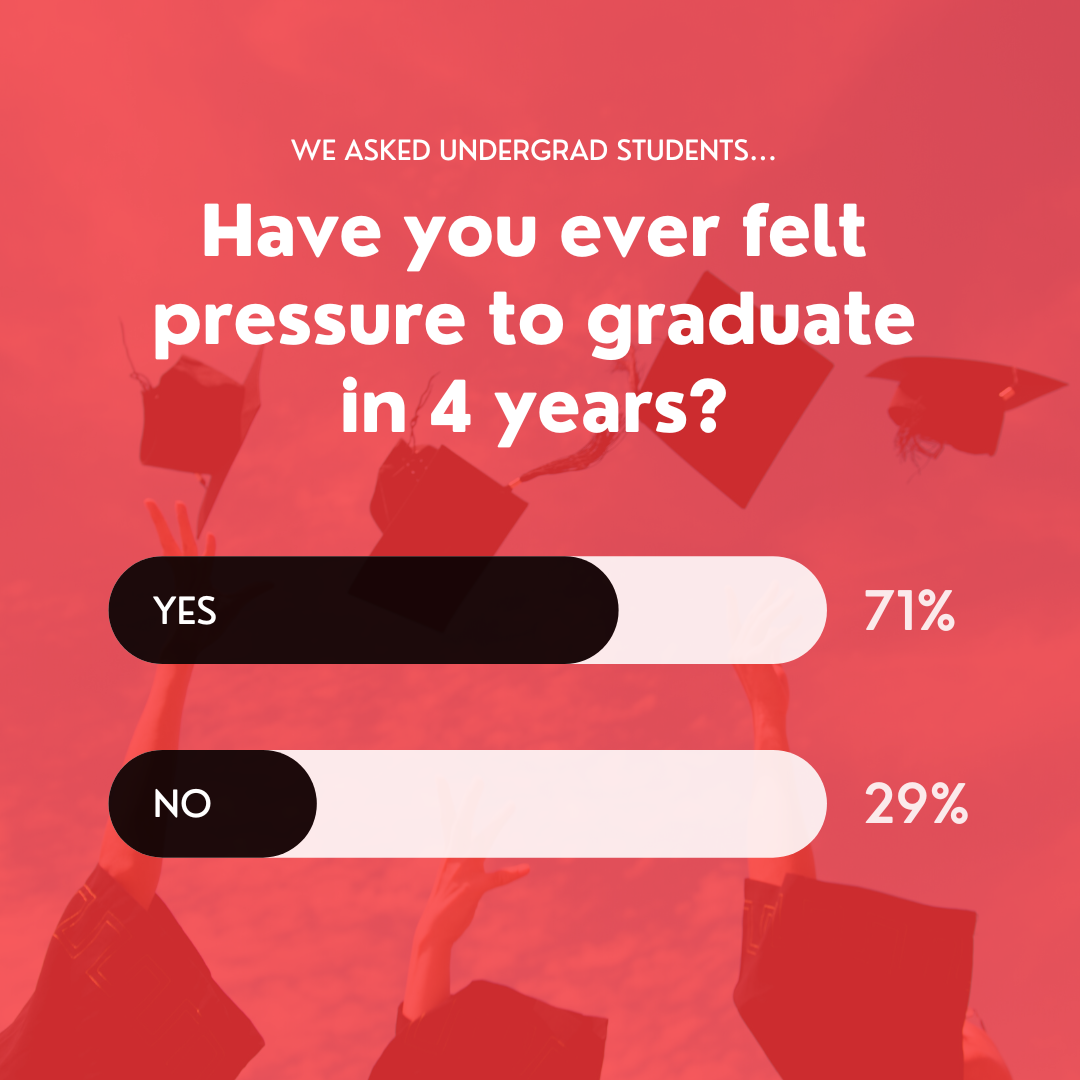
Why It’s Okay if You Don’t Graduate ...
Completing an undergrad degree only takes four years, right? Well, maybe not… and that’s okay! The new reality is that a lot of students don’t end up graduating in the traditional four year window. In fact, a recent CNBC study found that only 41% of college/university students graduate in 4 years or less. You may feel alone as you take a 5th year or feel stressed about planning to take an extra year or two to graduate, but clearly, you are not alone (I’ll give you a moment for a sigh of relief). Let’s take a look at some of the reasons why students like you might not graduate “on time”: Changing Majors According to the National Center for Education Statistics, approximately 80% of students change their majors before they graduate (I was surprised by this, too!). Depending on when you change your major (and for some, what you change it to), it can delay your graduation date. Although this may be discouraging to some, if you feel like the choice to refocus your studies on something else is helping you to reach your goals, then you’ve hit the jackpot! Taking an Internship TermThis is what I did. While it is taking me a whole extra year to graduate, I know that I’m so lucky to have ha -

Why You Should Have a Routine for Ba ...
Having a routine can be extremely helpful in times of unpredictability, uncertainty, and stress (and I know we’ve all had our fair share of these). A friend of mine, Ella Grant, a graduate from Bachelor of Health Sciences in Workplace Health and Wellness, notes “Having a routine can help decrease one’s stress levels, which can improve mental health and wellness. Essentially, the more you can decrease stress in your life, the better it will be.”It makes sense right? How often have you found yourself “winging it” during your day and then barely getting anything checked off of your to-do list? Does that lead you to become stressed?I hate to break it to you, but this probably happens because you haven’t set yourself up for success with a routine. Routines help you:Lower Stress Levels Unfortunately, a lack of a routine often means having a constant worry of “when will I get it all done.”Save Time Time is money, people! By following a routine, you’re able to stop wasting time (and of course when you stop wasting time, you are more productive and efficient) and free up time that would have otherwise been spent planning, decision making, and preparing. -

7 Skills Employers Look For & How to ...
Landing a new job is about so much more than just your past experience. Most employers are looking for well rounded people with specific skill sets that will make them a good fit for both the role and the company. Learn more about about the types of skills employers are looking for (and how you can demonstrate that you have them in an interview) ??Soft Skills and Hard Skills When applying to a new job or internship, there are some skills that employers will expect their employees to possess, regardless of the position. These are often referred to as “soft skills” and include interpersonal skills and other skills you might need to succeed in their workplace/organization. These might be things like teamwork, critical thinking, and communication skills. Employers will also often require more tangible or “hard skills” that are more in tune with professional or technical skills required to perform well in a given position (which means they are likely to be more specific). These might be things like computer skills, coding ability, or presentation skills. While employers generally look for a candidate that has a combination of both soft and hard skills, I would consider that soft skills are usually more sought after (mostly because hard skills can be taught on the job).“Having the ability to explain ho -

Why You Need Durable Skills & What T ...
The pandemic adapted how recruiters recruit because it changed just about everything in our world and that includes how businesses think. What employers need is more team members with the ability to operate, innovate, and lead with an inter-disciplinary approach that assures long-term growth, no matter the environment. Staying agile and having a competitive edge when it comes to the jobs you want means bringing durable skills to the workforce. So, what are durable skills and how do you highlight them with your prospective future employer?Durable skills, in many ways, are another vehicle of delivery for ‘soft skills’ in that whereas we once referred to ‘hard’ and ‘soft’ skills the on-trend language has veered toward ‘durable’ or ‘perishable’ and the categorization of these skills is now measured by their longevity. Here is a read.In essence, durable skills are skills that are long-lasting and can't be taught but are acquired by doing - through experience - while they also have a shelf life of at least 7.5 years. Durable skills are also easily transferred between job types and industries - the value of these skills doesn't diminish when the title or employer changes.Examples of durable skills include:design thinking,project management,effective communication,leadership,creativity,critical thinking,cognitive flexibility, problem solving,risk-taking, and,mental fortitude.Why is this important for you to know? 44% of recruiters note that they would hire someone with strong dur -

Meet Courtney Crites, McMaster Unive ...
Hi friends, and welcome to Outcome Campus Connect! I’m so excited for you to get to know me, and to have the opportunity to {connect}!My name is Courtney and I’m heading into my fifth (and final) year at McMaster University in the Honours Commerce with Internship program. If you don’t know what commerce is (there are so many people who look confused when I tell them what I study, so you’re not alone), I’m essentially in a general business degree program, but I get to focus on whatever interests me the most - which is both marketing and human resources. I’ve also already completed a minor in Innovation, which essentially focuses a lot on entrepreneurship, mostly because it’s interesting to me, but also because it sounds cool. Post-grad I’m hoping to go to college for a year to study public relations, and hope to get into something like corporate communications or influencer marketing, but of course, that is all TBD (to be determined).Over the past year I had the privilege of working in two internships, which were both phenomenal experiences. For 12 months, I worked as a Customer Success Intern for a tech company, which taught me a lot about relationship management, becoming integrated in an organization, and time management. Now, I’m just about to finish a 4-month Communications Internship for a municipality - this has taught me so much about communications, my ability to be creative and problem solve, and the importance of being adaptable to change.My biggest takeaways from my latest work experiences are:Don’t be afraid to ask questions - your coworkers just want to see you grow and succeed! Always offer your helping hand and show your eagerness to learn, and desire to immerse yourself in the company. Stay curious! Take advantage of networking internally and of personal/professional opportunities/workshops offered by your employer!As a new member of the OCC Content team, I’m most excited to get -

Building a Career Exit Strategy
You've likely heard of the concept of an 'exit strategy' as it pertains to business but have you considered the application of this concept when it comes to leaving the company you work to pursue something else? For those unfamiliar, an exit strategy is essentially your business plan in reverse. Just like you planned for how to build up your business, now you have to plan to transition what's been built without losing value, ideally, for all. When leaving your role, remember that although your time at the company you work for may feel over, at one point, the person you will be handing your resignation letter to was the person you eagerly gave your cover letter and resume. Leaving a job is a delicate dance, one where you must consider the optics, feelings, and legacy of your impression on your peers and employer. Here are some playful ways to apply the concept of a business exit strategy to leave your current role: Liquidation What assets have you helped to build in your role, within your teams, or your company's culture that you will no longer handle? If you can identify what you have built up and achieved while working within your role, you can provide your employer with a reflection on what you've learned during your time with them while reinforcing what you have contributed. You are not selling off the value of a business but re-selling your employer on the value you brought, which can help them appreciate what you've provided and more easily see the areas they will need to find a candidate to fulfill. Selling to Someone You Know (Keeping it in the Family) Although it's important to know that leaving a company and recommending a candidate to fill your role won't a -

When to Leave Your Job for a New One
Like so much of life, most jobs have expiration dates. Unlike that can of soup that lets your nose know when it's time to toss it, the signs that it's time to leave your job for a new are more nuanced. Over time, though, these subtle signs can feel like one big (flashing) ad with bold copy reading: "Move On!" or "I quit"! Before you reach that fork in the road, the little signs along the way can help you avoid being held back or stuck saying goodbye to your job with no new one in sight. If you're feeling any of the following, it could be time to leave your job for a new one: Boredom It's not like work is supposed to be super fun all the time but it shouldn't be so boring that you feel like you're watching the paint peeling - you know? What begets boredom is often lack of challenge and in a typical role this comes from your skills being underutilized (or unrecognized) by your employer. If you're not using your skillset, then you're not learning and growing - not good. Burnout Burnout is a tricky topic because the reason for each individual's burnout is very personal. Some experience burnout at work because of a combination of what they are tackling in their workload, work environment, or company culture, while others experience it because those things are combined with personal challenges. This said, if you have personal challenges but can't discuss anything with your employer, that might be a sign that it's not a culture you want to be a part of anyway. Your life is your life, and you only have one, do not waste it feeling less-than or shining less-than. Undervalued In truth, what you are worth and what you are paid won't always feel balanced but it should feel, at least, close. And, while this isn't -

A Look at Life as an Entrepreneur wi ...
A 23-year-old from Ecuador, gives us an insight on what it is like to be an entrepreneur of his own business, not only allows him to follow his dreams but finance his lifestyle. Life doesn't need to be linear; especially when it comes to finding your passions. There has always been a societal stigma that pressures young individuals to decide their future early. Discovering what works for you should not be, and isn’t, a straight-forward process. It’s not about graduating from school, going to university, then doing a Masters or getting a job. At some point in life, it becomes clear that it’s important to pursue your dreams. This is what Mateo Yanzza did and, for him, living your dreams means “nothing risked, nothing gained”. Yanzza had always dreamed of being his own boss. The freedom that comes with owning a business is liberating. Yanzza’s vision took him to make his dream a reality, as the founder and managing partner of his own business (Pragmatic). Where did you study and what field did you choose? I studied at the University of “Los Hemisferios” for 2 and a half years. There, I pursued business management. and discovered my passion was not being part of a company as a worker but to run my business plans. Did you graduate from college? Why or why not? No. After my 5th semester, I started to observe the world around me differently. Building my businesses from the ground-up was arduous work. I made the choice to leave my studies on hold to dedicate 100% of my time to my business projects to see where it would take me. -

An Interview with Jewell Gillies, Ab ...
1) What university or college did you go to and what did you study? I attended the University of the Fraser Valley, studying Criminology (2005) because at that time I was on track to be hired by the Vancouver Police Department and Criminology was my sole interest in education. 2) You work in Aboriginal Services, Seconded to Student, Graduate, & Co-op Employment Services at?Okanagan College. What was your journey like toward working in the community of higher learning and doing what you do now? When I graduated high school, my dream was not to work in the post-secondary field. In fact, I had already pre-enlisted in the United States Army, as a combat medic, and had been taking basic training on weekends and holidays. Shortly after I graduated from high school, I moved to the United States, where I completed my basic training and my method of service training. While I completed 1 year with the US Army, I then returned home to go to school and gain life experience to be a successful applicant to the Vancouver Police Department. Since I was 8 years old, I knew that I wanted to be a role model for my Indigenous community. Being a police officer seemed to be the most appropriate way for me to achieve that. At the age of 3 years old, my mother died, having suffered the traumas of residential school, which scarred her mentality. And, before they were adults, my 2 older brothers became addicts and lived homeless and deviant lives for over 30 years now. To me, becoming?a police offer was the best way to offset the injustice my brothers perpetrated on the world around them. It was also a way for me to be the officer that saved one young person from going down the same wrong path. While training as a police officer, I also&nb -

An Interview with Artist Rachel Hawk ...
1) What post-secondary institution did you attend and what did you study there? My education is a bit all over the place! After attending 5 different high schools, I moved from Toronto to Halifax to attend Dalhousie University, where I started in a General Arts program. After second year, I applied to the Architecture program, which required 2 years of an undergrad to be considered. The program was small and competitive, so I took Calculus and Fine Arts courses to boost my portfolio and was accepted! I completed that program (officially a Bachelor of Environmental Design) and took a year off to work and live abroad. I later returned to Halifax to complete my Master of Design at the Nova Scotia Academy of Art and Design. 2) How did you get into your industry and land where you are now? I worked in architecture for a while but did not find it to be as creatively fulfilling as what I had imagined. The house, the rigor, and the technical aspects just were not a good fit for me. So, I took the design still I had and the experience and education in the field of architecture to start working as an in-house designer for an architecture firm in Toronto. When I moved to Hamilton to start my family, I was so lucky to find an amazing roll at IKEA, as a designer at the Head Office. After my second child was born and I experienced the loss of my little brother very suddenly, I sort of fell into painting. But truthfully, my education and work experience have always had a thread of creativity, so perhaps it was all leading to this! 3) Describe your process - what’s it like? How long does a typical painting take? My process starts with a lot of water and washes of colour, which I let dry and layer to create energy and movement through the piece. Then I go in with sharper lines to “clean up” those organic shapes and create conver -

My Personal Journey to Become a Jour ...
Working with Outcome Campus Connect (OCC) gave me a taste of what to expect as a journalist and content creator. This journey has given me the ability to think outside the box and work efficiently. It is the first time I’ve worked as a student journalist, and here’s how it all began. When I first started out at St. Thomas, I felt a little lost - I didn’t know where I would see myself in four years’ time. I had a lot of self-doubt about my writing skills, since I had a huge disadvantage against other students: my language. (As an Ecuadorian, my first language is Spanish). I always felt like I was behind everyone on everything, every single day, and that was extremely frustrating. I even was “advised” by a teacher to look for another career, since I lacked the ability to be a good journalist; that really threw me off. I felt lost. I even considered switching careers, but I never found something that felt as right as writing. Even as a child, I carried a notebook with me. I felt like I became the words I wrote. I persisted in the face of doubt. Through this, and throughout college, I must admit that one of the biggest challenges of my life was learning to adjust, absorb new information, improve as fast as required, and apply myself and my work again. In this process, even in failure I won. I know that after four years I’m not the same lost person that walked into STU. I’m proud of who I have become as a writer, journalist, and individual. Overcoming all this didn’t just make me understand how much hard work pays off but the importance of good guidance. They say, “Everything happens for a reason”, and its cliché but true. Every St. Thomas class I took played a huge role in what I have become. I wouldn’t be able to edit audio, video, use a camera, or write a paper-edit rough cut, if it weren’t for Toolbox. -

What Makes Our Platform Different & ...
We're well aware that Outcome Campus Connect is not the only opportunity platform but we're doing things differently and in ways that will make a difference for you. This entire platform is built for you and that's what makes it really have influence. The way that our team approached building this platform is with the intention of giving every university and college student at least one work-integrated learning experience before graduation.Why does this matter?Employers want you to have experience to get hired but you can't get hired without gaining experience first, in the majority of instances. This said, there are other platforms who are trying to fill the skills gap and help you get hired but none are doing it quite as holistically, with wraparound support, as we are.Here's what makes our platform different and why it will make a difference for you:This platform is partners with universities and colleges across the country, which enables employers to post job opportunities through Outcome Campus Connect by specifying which universities or colleges they want to hire from and funneling the opportunity not just onto our live site but into the opportunity platforms of our campus partners, nationwide.The opportunities you see on our platform as put there by hiring managers or recruiters who are building early-talent recruitment pipelines, meaning, more often than not, the opportunity you see is for someone with 3 years of experience or less - a student or recent graduate, like you.Skill development (internships, co-ops, work placements, research projects, etc.) and job opportunities that you see on Outcome Campus Connect are targeted to specific years or fields of study (at specific universities or colleges) so you know that the employer that is hiring on our platform has already been carefully considering the type of talent they bring on (that's you).The opportunities that you see are Ou -

Your Resume Looks Good but What Abou ...
We don’t mean to alarm you with the title, we’re sure you’re nice; and your personality has rave reviews. This said, not all personality types are a fit for all work environments. That’s why we’re showing you, below, the type of personality tests your prospective employer may use as a tool to vet whether you are the right fit for their team or not. Personality Test Types – What to Know Myers-Briggs Type Indicator Background & How it Works Often referred to as MBTI, Myers-Briggs Type Indicator is a personality test inspired from the teachings of Swiss psychiatrist Carl Jung, who speculated that human beings universally experience the world using our sensory perceptions of sensation, intuition, feeling, and thinking and the test itself was produced by a mother and daughter – Isabel Briggs Myers and Katherine Briggs. The MBTI test is a tool that determines which four groupings, derived from Jung’s theories, an individual falls under: extraversion vs. Introversion, judging vs. Perceiving, intuition vs. Sensing, and, thinking vs. Feeling.8 After taking a 20-to-40-minute test online, for free, your answers will then funnel through the four groupings and place you as one of the possible 16 possible personality type categories (outcomes/c -

How to Use the STAR Method in an Int ...
Remember: Situation, task, action, and result. Simple enough, right? Simple is good and it's memorable, which, in this case, is very good. Often the most complex interview questions derive from a competency-based inquiry. For example, “Tell me about a time when you faced a challenging situation and what you did about it.” If you have work experience – if you have been an intern, worked co-op or in a work placement, or flexed your career as a part-time employee – it will be easier to seamlessly answer a competency-based question in an interview. If you have not, there’s no time like now to think on moments in life that have tested your skills and encouraged problem-solving to good results. Suffice to say, using the STAR method will help in any interview and here is how you do it: When you’re asked to reflect on or elaborate on a time you faced a hurdle and overcame it start with ‘S’ and work your way to ‘R’: Situation – Communicate the foundational information to lay the groundwork for their understanding of what the situation was that you were faced with. Task – Explain your role within this situation, for example, were you a team lead or a support? What was it that you were specifically tasked to do? Action – Explain what action you took within the context of this role and this situation outlined. Result – Give a high-level overview of what the result was in the scenario you have been discussing and how achieving the desired result helped the team to overcome the obstacles or hurdles that threatened progress initially. Don’t hesitate to explore what you learned from the entire process. Example: Question: Tell me abo -

Travel While Working or Work While T ...
Did you ‘catch the travel bug’ for good? You’re not alone and you don’t have to give it up. If a life of travel is a way of life for you then it’s time to consider a career in travel. Now, post-pre-whatever part we’re in, globally, pandemic-wise there are so many career options to consider because not only are their roles that require and empower travel but remote means the geographic point where you work is changeable. This said, here are a few career choices that will support you to travel, while working - or work while travelling! Tour Guide: As a tour guide you lead groups who have paid the business you work for (or you) through various regions, ensuring the safety and overall experience of customers is fulfilled. This role means you’re always learning, immersing yourself in various cultures, perhaps acquiring new language skills, and adventuring. - Companies to consider: G Adventures. Butterfield & Robinson Retail Buyer: As a retail buyer you are responsible for planning, budgeting, managing, sourcing, testing, and sourcing the products or apparel items that a company sells and a big part of this means visiting suppliers internationally or ‘sourcing’ the right items to maintain and expand sales. - Companies to consider: Aritzia, Zara, Hudson’s Bay -

The Prosperity Project, By: Eileen N ...
The Prosperity Project is a registered charity created to mitigate the effects of COVID-19 on Canadian women and girls. Led by a group of more than 60 trailblazing women leaders, the project strives to explicitly link women and prosperity by underscoring the economic importance of gender equality. To achieve this goal, The Prosperity Project has launched five initiatives, one of which is the Modern-Day Rosie the Riveter-Inspired Initiative. I sat down with Amadea Gareau, Rosie Initiative Program Manager at The Prosperity Project, to talk more about the Rosie Initiative and the upcoming internship opportunity for a co-op student this fall 2022. Keep reading to learn more about The Prosperity Project and what students can expect for this internship role. What is the Rosie Initiative? The Rosie Initiative was inspired by the iconic figure of Rosie the Riveter during World War II. Rosie’s , “We Can Do It!” rally call made her a powerful symbol for women’s independence. Today, the Rosie Initiative continues to encourage women and girls to rejoin or stay in the workforce and contribute to the Canadian economy. The Initiative’s vision is to increase women’s labour force participation and the number of women in STEM (Science, Technology, Engineering, and Math), skilled trades and leadership roles. Since women are typically under-represented in these areas, the Rosie Initiative wants to ensure that women and girls can have access to the role models and mentors they need to succeed in these careers. What are some programs established under the Rosie Initiative? Currently, the Rosie Initiative has two mentoring programs available for women in STEM, skilled trades, and leade -

What You Need To Know About Getting ...
Deciding to go to graduate school is one of the most important academic decisions that one could make. I sat down to talk to my friend, Aleena Dar, who attends the University of Toronto about her experience with pursuing a Masters in Community Development. Aleena is one of the most motivated, career- driven, and outgoing personalities I have had the pleasure of meeting. She recently started her graduate studies and had valuable insights from her experience in pursuing graduate studies. Q: What made you consider going to grad school? A: I’m being quite honest, my parents. They always wanted me to pursue a masters and that was logical, especially because my degree was too broad, and I wanted to specialize. Q: How did you decide what you wanted to study further? A: During my undergraduate, I had a part time job within the university and made a lot of connections. My mentor’s job appealed to me greatly and I started to consider it as a serious potential career choice. I partook in a lot of varied work opportunities and volunteer experiences but, her job was what I felt most resonated with me. Q: What was the most difficult part of the application process? A: I applied a little later than expected. I also did my research late too, around the end of fourth year and I only applied to one program as that was what I most wanted to continue my studies in. As I was underprepared, it was a bit difficult getting the documentation, and ensuring all components of the application were fulfilled. However, I had developed a good repertoire with my professors -

The Most In-Demand Roles in Tech Thi ...
Looking to break into a career working within tech? Not a bad idea, considering technology underpins every corner of society and its use will only grow with the coming of the 'metaverse' and our increased reliance on remote connection, streamlining and documentation of processes, innovation, and data analytics. This year, the top trending occupations within technology include: Developer/Programmer IT Project Manager Cloud Architect Business Analyst Security Analyst/Architect Business Systems/ Data Analyst Network Engineer Quality Assurance Specialist Here's what you will do working in each of these roles and how much you can get paid: Developer/Programmer As a developer or programmer you interpret technical specifications, designs, flow charts, and sometimes creative briefs, and use code and other tools to adapt or build software applications. In fact, you may be in charge of constructing the specifications, in the first place. Once the work is complete, you are responsible for testing your prototype and design thinking to ensure it is well executed and identify growth opportunity areas. Salary range: $60,000 - $125,000 + annually IT Project Manager As an IT project manager you oversee, delegate, and ensure smooth reaching of an organization and its departments' IT goals. This requires an advanced knowledge of computers, systems, networks, resource planning, budgeting, and more. Salary range: $77,000 - $135,000+ annually Cloud Architect Cloud architects are specialists in data storage fundamentals, Java, networks, security foundations, front-and-back-end technologies, b -

Becoming a Strategy Manager, By: Ari ...
What is a Strategy Manager? Strategic managers are the key planners, analyzers, and risk leaders who establish strategic plans in a business. They also handle oversight and development of corporate strategies to support business growth and stability. Strategy Manager Activities:Planning Risk management Performance management CoachingCollaborationData analysis Crisis managementCreative problem solving Ethics development Market leadership Creating value BrandingWhat Education do Strategy Managers Typically Have? Degree in business or related field, MBA preferred. 3-5 years of experience in business administration, management consulting or strategic planning. Excellent understanding of business operations and procedures, or branding. Excellent communication and interpersonal skills. What Essential Skills should Strategy Managers Have? Communication skills The strategic management position is collaborative and demands great communicators in speech and writing. As business leaders, strategic managers need to inform and instruct all employees. Proper communication will determine the effectiveness of the instructions they give.Exceptional communication skills are essential when interacting with consumers, gathering information, expressing oneself and preparing business reports Analytical skills Strategic managers need to convert raw information into applicable strategies. They should also be able to perform various standard analyses in the business, such as:- Competitive analysis: Assesses the strengths and weaknesses of their competitors< -

Content Marketing Trends Dominating ...
The social media world is always evolving. In this modern world, the art of posting has become a phenomena - a key tool to build a brand or image. Learning the correct way to generate content and speak to a targeted online audience is critical for strong social media presence. It is challenging to engage with your target audience through social media because it is a highly competitive arena. Due to the saturation of social content from brands and individual, globally, companies can easily hit a wall of doubts and feedback loops. In this article, we’re discussing the top social media marketing trends emerging this year and how to harness these tactics to empower your hopeful career in marketing, content, brand ambassadorship. or social media marketing! -

Breaking News: Canada Post-Graduate ...
Recent international post-secondary graduates in Canada can now apply to extend their post-graduate work permits. Are you one of these 100,000+ grads looking for an extension on your post-graduate work permit? Here are some resources to help unpack what this means and how to make this PGWP (post-graduate work permit) extension work for you: "New Measures to Address Canada's Labour Shortage", Government of Canada "IRCC to resume FSWP & CEC invitations in July; and offer open work permit to PGWP holders", CICI News, The Voice of Canadian Immigration, Shelby Thevenot and Kareem El-Assal "Canada to Provide Another PGWP Extension", Canadian Immigration Law Firm", Lauren Boorman "Minister Sean Fraser, why exclude us from the post-graduate work permit extension?", Toronto Star, Minu Matthew "Canada Work Permits Extended for International Graduates", PIE News, Helen Packer Oh, and we've got jobs for you (from employers across Canada seeking recent grads)! Sign-in or up to start searching. -

50/50: Exploring Your Career Path a ...
Finding your calling or career path is a struggle for most of us. I can say in my personal experience, that even if I knew I wanted to study journalism there were so many classes to choose from that I found myself lost. The guidance of a professor helped me choose courses wisely and shaped my career trajectory to-date. I spoke with Erin Feicht, Career Development Advisor at St. Thomas University, to get a better understanding of the path of discovery for students to experience and determine their hopes for career paths. Fortunately, the university offers plenty of paths for exploration, it’s important to take a variety of courses to gain knowledge and experience on different topics. According to Feicht, “50% of students that enter post-secondary have a clear idea of what they want to study, while the other 50% either have some areas of interest or are totally lost in a world of possibilities.” She strongly advises students to seek-out advice, and be open to the process. Her process is (about) four steps: Resume Building Interview Preparation, Networking Techniques Extracurricular Activities [Text Wrapping Break] The brainstorming process is important because it reveals the ways that students can gain experience and build skills while in university. Reflecting on where you want to go can help pinpoint interests and reveal where to look for internships or experiential learning opportunities that will lead you to the job you want when you graduate. Feicht also notes that it’s important to understand the salary bracket of the career you’re pursuing, to prevent unmet expectations. Choosing a career sho -

So, You Want to be an Urban Planner?
What is an Urban Planner? Urban planners work with developers and their communities to realize development proposals while solving social, economic, and environmental issues. As an Urban Planner You Will: Plan and design transportation infrastructure policy Undertake planning and engineering work Communicate with lawyers, architects, finance, and risk people (to name a few) Coordinate with local governments Create and interpret maps and diagrams Recommend and approve or deny proposals What Education Do Urban Planners Typically Have? To be an Urban Planner you need a master's degree in Urban Planning but Urban Design or Geography is also applicable. In pursuit of a master's program you can start by graduating with a Bachelor's degree in economics, geography, political science, or environmental design. What Essential Skills Should Urban Planners Have? research writing analysis communications sales/outreach creativity interpersonal skills What Industries Hire Urban Planners? Government Higher education Real estate developers nonprofits landscape architecture and planning firms What is a Typical Urban Planner Salary? The salary range for an Urban Planner is $70, 135 - $111,000 and the median salary for this role is $90,000 per year ($46.15 hourly). -

Journalism Will Always Be Journalism ...
"Journalism is the same; we have just changed the vehicle in which we communicate it," Pablo Herraiz, Investigative Journalism Reporter for EL Mundo. The pandemic accelerated the digital era of journalism. Since the onset of COVID-19, people have consumed news 50% more than pre-pandemic and at all hours. In addition, the media bridges people in isolation or at home, living remotely from friends or family elsewhere, to the outside world. I had the privilege of interviewing Pablo Herraiz, Investigative Journalism Reporter for El Mundo, Madrid, Spain's largest newspaper, and exploring how the pandemic has influenced the profession of journalism – from how we consume the news to how journalists deliver it. Pablo Herraiz started working 20 years ago for El Mundo, one of the top newspapers in Madrid. According to him, one of the most significant challenges of being a reporter is generating new information every day. For example, after the pandemic hit, many people were told to stay at home and work from there. But for a journalist, working from home is not the most effective way to get a story - even if the workplace can present it as a benefit. "Before the pandemic, I was always in the streets looking for stories, people to interview, or covering events, but now, that is lost." While journalists adapted to working from home, anywhere in the world, they also adopted new methods to support getting the job done and delivered in the format that was now widely consumed. Journalists can now more easily access information about government, trials, speeches, etc., which would be harder to follow on foot because everything, absolutely everything, is now online. Instead of face-to-face interviews, platforms lik -

Three Benefits of Language Learning, ...
One of the personal goals that I have been striving for is to learn a new language. In the past academic school year, I’ve had the opportunity to learn Japanese, a language that I’ve wanted to learn for a long time. I never thought I would enjoy learning a language so much, and I’m grateful I had the chance to do so. Learning a new language comes with many benefits, and today, I want to share with you why you should consider learning a language and some tips and tricks to help you get started! Three Benefits of Language Learning 1. You get to learn about another culture You can learn a lot about a culture just by studying their language! When I was studying Japanese, I found it fascinating how Japanese has different approaches to certain social situations and how it has words to phrases that don’t even exist in English! I appreciate my sensei (Japanese for “teacher”) for sharing a bit of her culture with me. It is not every day that you can engage with cultures and communities outside your own, so language learning is an excellent opportunity to do so! Learning about other cultures is not only fun, but it also widens your perspective. Especially today, the world is getting more connected through technology, and it is important to be open and ready to learn about different cultures. 2. You get to connect with different people outside your own culture Learning a new language also allows for your network to expand. You will get the opportunity to interact with many other people you could never have interacted with because of a language barrier. Creating those new connections can aid you in your personal life, your professional career, or even when travelling to other countries -

The Career Journey of Journalist Mat ...
“Going into university, I kind of always knew what I was going to study because my dream job was to be a sports broadcaster. I love sports but I'm not very good at them, so I figure talking about them would be the next best thing,” Matthew Daigle As a 10-year old Daigle was already thinking of diving into the world of journalism. He used to pretend to be an announcer at family game night or his sister’s hockey games, shaping Daigle’s idea of what we wanted to pursue in the future. “I used to always watch hockey with my family and there’s always an announcer for the games, so I would pretend I was the one calling the game." Miramichi, his hometown for 17 years, incentivized Daigle’s decision to move to another province to get his degree since they only offered a community college at NBCC as post-secondary education. Some of his options were: Quebec, Halifax and Fredericton, which were liberal arts institutions. His decision making took a last turn when he accepted admission to St. Thomas University (STU). “After knowing what I didn’t really like in high school like chemistry and physics, I understood that writing was my passion, something that motivated me and I wanted to go to a school that would expand on that knowledge.” His main reason for choosing STU as the next 4 years of his life was being close to home. In the end it all came down to being able to go back during holidays or special dates and feeling close to the family. The second reason was being able to work alongside the CBC newsroom professionals, whose knowledge and professionalism caught Daigle’s attention. In the fall of 2017 he arrived on-campus and took his first steps toward his hopeful career as a journalist. Going into univer -

Freelancing: An Interview With a Fi ...
What is freelancing? 'To freelance' is defined by Google as: Working for different companies at different times rather than being permanently employed by one company. In fact, Google’s workforce, as of 2019, consists of more contractors/freelancers than permanent employees - 54% of the staff were considered contractors/freelancers! Forbes even has an articl -

Are Summer School Classes Right For ...
We are now approaching that time of year when classes are finally wrapping up, and all that’s left to do are those last few assignments before you can relax and let loose for summer break. Summer break = no school… or so you think. You might have heard the idea of summer school floating around, and although the last thing on your mind right now is doing even more school, summer school can be a great opportunity in your educational path. However, it is important to know if summer school is right for you before signing up because it can be very different from the courses you take in the regular school year. So, here is a list of some of the pros and cons of summer school. PRO #1: Summer school can help you graduate early If you are looking to graduate early, summer school is an excellent way to do so. By taking additional classes during the summer, you can work towards your degree quicker than if you were only to take courses during the Fall/Winter term. TIP: I would highly recommend researching and planning which classes you need to take. It can be tricky to find out what classes you need. Consider visiting your Academic Advising Offices to ask for help in planning your course loads for both the Fall/Winter and Summer terms. PRO #2: Summer school can help spread courses out throughout the year Enrolling in summer school could allow you to take a lighter course load during the Fall/Winter term, spreading out yo -

Why Fake It 'Til You Make It is Bad ...
“Fake it ‘till you make it.” Sounds like solid advice right? If you’re not confident, just pretend that you are and the confidence will follow. Not so fast! As a new grad, who has gone through the interview process many times, I've learned to do better. Knowing what you're doing is one thing but admitting when you don't know can be much more valuable. In fact, it tops my list on why you should NOT fake it 'til you make it. 1. Admit When You Don’t Know I promise, it’s going to look a lot better if you&rsqu -

Tips From Professors on How to Ask Y ...
It is no secret that working or learning remotely or in hybrid learning environments makes it challenging to connect with professors. If you’re like me, you’ve likely reached a point in your academic journey where you need recommendation letters - either for a job or graduate studies. So, how do you ask for letters of recommendation when you’ve been interacting with your class mainly online? I spoke with a few professors to ask them insights on teaching in this new environment and how it impacts what they look for in students’ approaches to asking for recommendation letters. Here are their tips: Show Up & Turn Your Camera On It seems simple but when students show up every day, turn on their camera, and regularly share their thoughts it’s easier for professors to reason writing letters of recommendation. Share Your Future Hopes & Dreams With Professors The professors I spoke with expressed that they would prefer to know your future plans and that the more details you can provide, the better the chance of getting a letter of recommendation – and one that will have an influence. Also advised, is to share your CV, cover letter, or any other information that can support you to get a letter that is tailored to your strong suits and aims. Express Interest in a Letter of Recommendation Early-on Asking for a L.O.R. is nerve racking enough when you are in-class but especially difficult due to the lack of interaction of online classes. Some advice offered by given by professors I spoke with is to express interest in a L.O.R. early-on (also, obviously: go to office hours, ask about the exam, engage in class, and build a rapport with them). Quality & Content -

Lollipop Moments: Redefining Leaders ...
Today, I wanted to share a video that my team shows us every year as a reminder that leadership is not always about grand gestures and breakthrough moments but can be something as simple as a kind gesture or a helping hand. In the Ted Talk above, Drew Dudley does a fantastic job redefining leadership. I encourage you to watch the video when you get the chance and think about your lollipop moments! This could be a moment where you impacted someone in a small way or a situation where someone else has impacted you. Many times, the word ‘leadership’ can be daunting because there are preconceived notions about how a leader should be—assertive, taking charge, and being successful—but I wanted to show how leadership is not always like that. Even small actions of leadership should be celebrated. To drive home this thought, I wanted to share with you my lollipop moment of a professor who greatly impacted me during my time at university. In my introductory blog post, I talked a bit about myself, noting that I’m studying English and Philosophy. Although the reason I decided on being an English major is straightforward—I simply love reading, writing, and analyzing text—the reason I also chose to study philosophy is very different. In my first year, I took a wide range of courses to see what other courses were available, and I took an introductory philosophy course to see what philosophy was about. The content of the course drew me in, but what sparked my passion for philosophy was the professor. My professor always came to class with a bright smile on his face, delivered his lectures with extreme giddiness and passion, and always made classes so enjoyable. For that reason, I decided to continue studying philosophy, and to this day, he is still one of my favourite -

Meet Deanne Williams, English Profes ...
I had the pleasure of interviewing Deanne Williams, an English Professor at York University as well as author. I took her class this semester and had the incredible opportunity to become acquainted with her. I chose to interview her on Women’s History Month as I wanted to showcase a female professor excelling in her field in a relatively male dominated field. If you're interested in pursuing English as a major, minor, or a profession, keep reading to learn more about Deanne’s journey and advice. Q: Tell me a little bit about yourself. A: I studied English and Religious Studies at the University of Toronto. I got to study with Northrop Frye (Author of international bestseller Fearful Symmetry). I also completed my graduate studies at Oxford and a fellowship at Stanford where I took part in field work as well. Close to my final year, I was offered a position at York University, completed my dissertation, and joined the English department at York. Q: Did you always know that you wanted to become an English professor? A: No, I thought maybe I would go into publishing. I also thought maybe I would get involved with law and find a way to interconnect the two. The moment I knew that I wanted to go into graduate school, I was in my third year of university and enjoying my courses so much that I realized I just wanted to continue studying. I had a prophetic vision and dream that I would go to graduate school in California. Q: Which steps did you take? Did you have any guidance? A: I became quite close with the Dean of English Studies at my university, and he actually proposed that I go to Oxford to pursue Medieval Studies. A little later, I continued my graduate studies at Stanford. I got to study alongside several wonderful scholars. I had a friend from -

About Peer Mentorship, From a Peer M ...
I have been a peer mentor at York University for the past two years, and it has been one of my favourite student experiences. In this role, I support and mentor first-year students, whether that be answering any questions they have, helping them adjust to their first year, or just being there as mental and emotional support. Are you interested in being a peer mentor? What is a Peer Mentor? A peer mentor is usually an upper-year student who helps first-year students transition into university. If you are a first-year student, a peer mentor will often lend a hand in guiding you through your first year at university. From study sessions to campus tours to fun social events, they are an accessible connection that can help you become more adjusted to student life. Even if you are no longer a first-year student, it can still be helpful to reach out and ask questions. As a fourth-year myself, there are still many things that I am still learning about my university and program, so it’s really helpful to have someone to talk to. What can a Peer Mentor Help me With? A peer mentor may offer services such as one-on-one counseling, group study sessions, and many more. One-on-one counseling can include assignment or essay help, such as going over the assignment requirements or giving essay writing tips, or it can be more casual sessions, such as talking about mental health or academic stress. Peer mentors may also host study sessions throughout the year or even hold events that you can attend. Academic events, such as writing or resume workshops, help you develop more professional skills, while social events, such as game nights, provide a space for students to connect and socialize. Your peer mentors are there to make sure your first year is as fun, stress-free, and successful as possible! My Experien -

Why Humanitarian Work Should be on Y ...
I wouldn't recommend underestimating the value of volunteer and humanitarian aid experience. Not only can humanitarian aid experience be grounding but it also empowers networking, skill development, and a sense of belonging to something bigger than ourselves through community. A few years ago, I took part in an initiative by my high school that focused on poverty alleviation in a small city in Malaysia. For a year, we worked through various fundraising projects to collect enough money to help kids in Sabah, Malaysia build a school for their community. There was an option at the end of the school year to go to Malaysia and actively help in building the school. Truthfully, the cost of the trip, as well as the fact that it would take up most of the summer, almost deterred me from going. However, I really wanted to be able to see the village and people for whom our team was collecting funds. Luckily, I did go and the highlight was meeting the kids, teachers, and the community in-person. Connecting with people, learning how to lay cement, carrying barrels of rocks and construction equipment...everyday was tiring and incredibly rewarding. My friends and I learned so much during the trip that we implemented the practical and theoretical lessons into our lives when we returned home. I share this with you because as a third-year student of York University, I found myself hesitant to even apply for many of the internships I was interested in because I didn't have work experience but decided to take a chance on myself and apply anyway. Much to my delight, I did secure an internship with Orbis and Outcome Campus Connect, and have recently landed a summer internship for Public Policy. Both times, my volunteer experience, genuine interest for their companies, and willingness to learn gave me a competitive edge. In short? There are so m -

5 Ways to Connect with your Campus C ...
For the past two years, going to school meant signing onto Zoom. Unfortunately, with everything being online, students have found it way harder to connect with their community, make new friends, or experience university life. It’s already hard enough transitioning into university from high school outside of a pandemic; it is now especially challenging because of the lack of in-person interaction. Community is one of my favourite parts of the university experience—you meet so many new people, gain new experiences, and enjoy school more. So, whether your university has finally returned to in-person learning or decided to stay online for the rest of the year, here are five ways to get more connected with your school community: 1. Attend events and participate There are always so many events happening around campus. These events are an excellent opportunity for you to meet new people and engage with your community. Events can be academic-related, such as writing workshops, or social, such as game nights and competitions. As someone who has attended and organized many events, I can vouch that they are always super fun! Some examples of events my team has helped organize are a speed-friending event, a gingerbread house competition, and even a drag race! All you have to do is sign up, show up, and participate! These events are a great way to meet new people and have some great fun along the way. Most universities will have social media accounts or weekly newsletters to inform students of upcoming events. Keep an eye out for these events, register, and participate! 2. Join clubs and organizations Another great way to connect with others at school is by joining a club or organization. There are always plenty of student-run clubs all around campus -

These Four WFH Tips Made My Days Bet ...
As a new graduate who completed half of her post-secondary education online, did two fully remote internships, and has received both in-person and WFH positions, here are four things I’ve started incorporating into my work-from-home (WFH) routine to help create better work-life boundaries and succeed in my positions. — Wake Up Early—Or At Least Try To It can be super tempting to roll out of bed 5 minutes before your work or school day starts and just jump into it. It’s easy, takes little to no effort, and sounds like a great idea if you’re not a morning person. But doing that blurs the boundary between work and general life. If the first thing you do in the morning is start working, what is there to stop that from being the -

The Work Environment: Does it Work f ...
As a pandemic grad, I know how intimidating finding a job can be. Online applications can be daunting and online interviews can be few and far between. So it’s a huge relief to receive an offer of employment from somewhere finally, and most new grads, myself included, jump at the opportunity immediately. Something you should remember is that as much as employers are vetting you through the interview process, you’re vetting them too. Part of the interview process for them is seeing if you fit the company. So during the interview and probationary period, you should also be seeing if they’re a fit for you. But how do you know that place is right for you? What should you be looking for in a place of employment? Here are three questions I’ve kept in mind throughout interviews and during my time working. —— 1. What is the Training Process? How do you learn best? Are you someone who needs to walk through the process of doing something a couple of times before picking it up? Are you someone who likes figuring out how to do things independently? Do you like taking notes while being shown what to do so you can follow your takeaways for future reference? Think about all this, and ensure that employers can appropriately accommodate what you need to fee onboarded. As new grads, you’re not going to know everything about the field you’re entering. There will be a training process, whether on procedures, protocols, software, hardware, and more. If you’re told that the training process is relatively hands-off and you need that extra guidance, maybe that isn’t the place for you and vice-versa. 2. What is the Management Style? Is management overly involved? Distant? Available? Take -

Meet Brenda Nguyen, OCC Content Writer
My name is Brenda Nguyen, and I'm a recent (honours) graduate from Humber College’s Graphic Design program! Since graduating, I've been working, 'in print', as a Junior Prepress Technician and, 'in digital', as an OCC Student Journalist. I also run a small business (NGYN Designs) and volunteer in content creation with AZN Zine (creating social media posts and layouts for their digital and print magazine), and with my local church. In short? I do a little bit of a lot of things...and I'm learning how to manage all these 'things' as I go. I am super excited to join the OCC content team as a student journalist and to grow my experiences and knowledge about digital content creation. I will be sharing my tips and tricks on graduating, job-seeking, and working throughout a pandemic because these are subjects I always navigated, and am still navigating, and wish someone had shared with me. Hopefully, by imparting what I’ve learned (and what I’m continuing to learn), I can help ease some of the anxiety of graduating and job-seeking in a highly competitive and unprecedented environment. -
Celebrating Black Diversity in Canad ...
With the arrival of February comes Black History Month, a time to celebrate and reflect on Black history in Canada. Diversity always has and will always be part of Canada, and today, Canadian society is proud to accept people from different races and backgrounds. However, we must not forget that racial discrimination persists even in 2022, and we still have a long way to go. In celebration of Black History Month, here are three notable Black Canadian figures that have paved the way for Black Canadians. Even after February passes, let’s continue celebrating Black diversity all year long. The Honourable Jean Augustine In 2002, the Honourable Jean Augustine became the first Black female MP and Cabinet minister in Canada. Later that year, she was also selected to be a member of the Queen’s Privy Council of Canada, and in 2003, was appointed as the Minister of State (Multiculturalism and Status of Women). In parliament, Jean Augustine served for three terms as Chair of the National Liberal Women’s Caucus. In 2005, she retired from politics but remained actively engaged in advocacy work. In 2007, Ontario appointed her as the first Fairness Commissioner, an office that ensured foreign-trained professionals received the credentials required to work in Ontario. In 2014, the Jean Augustine’s Centre for Young Women’s Empowerment was founded, an organization that supports the well-being and prosperity of young women and girls. In the mid-1990s, Jean Augustine played a significant role in establishing Black History Month in Canada. Back then, many communities celebrated Black culture and history informally, but it was through Jean Augustine’s support and push that aided the unanimous agreement that February would be named Black History Month. (The Canadian Encyclopedia). -

Meet Eileen Nugraha, York University ...
Hi there, welcome to Outcome Campus Connect, and thank you for stumbling across my introduction! I’m Eileen, a fourth-year student at York University, currently studying English and Philosophy—a weird combination, I know, but not as weird as you think. Philosophy has a lot in common with many areas of study and it has enhanced my learning—but that’s a story for another time. I’m a new content writer here at Outcome Campus Connect, and so excited to start this position. Ever since I remember, I’ve always had a passion for writing, creating content, and engaging with various communities on social media. In the beginning, I started with a small Instagram account dedicated to book reviews and now I help run social media channels for school and work. One of my favourite aspects of content creation is how creative you can be—the sky’s the limit, and I love exploring new avenues of creativity. I’m so excited to work with Outcome Campus Connect to continue my journey in learning more about content creation. Please keep your eyes out for my future blog posts, and I hope what I write and produce 'connects'! -

Is Loving Your Job a Unicorn with a ...
Studies have shown that over half of Canadians hate their jobs and over half of our country's senior managers are considering quitting due to exhaustion: Is the idea of loving your job 'a unicorn with a rainbow horn'? While statistics give us a meager fifty-fifty chance of happiness in our jobs, studies also show passionate workers outperform their peers, accelerating their career journeys. The trick to landing on the upswing of that fifty-fifty is to see each role, even the ones you aren't excited about, as an opportunity to learn something new, improve, and advance your personal career journey. To back us up, here is how some wickedly successful people started their careers: Jeff Bezos - McDonalds Bernie Sanders - carpenter Elon Musk - lumber mill worker Ellen Degenres - oyster shucker Richard Branson - amateur 'bird breeder' In short, your first roles won't likely be love at first sight but will teach, test, and strengthen you for what's next. Like any good 'unicorn', your ideal role will also be hard to catch, rare, and highly valued aka: extremely competitive. This said, the only myth in finding your ideal role is that it's luck - the competitive advantage you need to end up where you'll truly love your job is acquired through skill and experience building - through time. This said, here are 3 easy ways to (try) to love your job (even if you don't like it): See it for what it is: A stepping stone. This means approaching your days strategically so that you squeeze the most value out of your work for your personal and professional (hard and soft skill) development. Write down a list of skills and experiences you want to be able to own a -

The Seven Worker Archetypes + How Pa ...
Is 'the only way to do great work, to love what you do'? Steve Jobs thought so, and he was worth $250 million by the time he was 25, just over two decades following the launch of Apple, with his friend Ronald Wayne, out of Job's parents' garage. Finding passion in our careers and applying ourselves to grow professionally is essential. As seen in a study by Deloitte University Press, "Passion at Work: Cultivating worker passion as a cornerstone of talent development," passionate workers outperform non-passionate peers. The study outlines seven worker archetypes and the virtues of passionate vs. non-passionate workers. "Passionate workers," sometimes also referred to as "Explorers," exhibit three consistent characteristics questing, connecting, and, commitment to domain. 'Questing' means: the drive to go beyond core responsibilities. constantly probing consistently testing, pushing boundaries, seeking out new opportunities, learning new skills, resourceful, imaginative, Non-complacency - always seeking out the next level of achievement. 'Connecting' means: seeking out others to help find solutions to challenges they are facing, searching for deep interactions with others in related domains to attain insights they can bring back to enhance their approach and improve their value (vs. 'networking), building connections not for the sake of a larger network but to bridge deeper meaning in their careers an -

You Miss 100% of the Shots You Don't ...
Whether you're studying sports marketing, sports administration and business management, sports management, recreation and leisure, sport conditioning, or maybe even something entirely unrelated to sports but you'd like to gain applicable skills to apply to your hopeful industry, be a good sport and check out these 15 job opportunities on OCC NOW: Marketing and Advertising Coordinator, Elite Soccer Clinics Ice Hockey Scorekeeper, JAM Sports Toronto ASICS Running Apps, Development Manager ASICS Running Apps, Development Manager, Technical ASICS Running Apps, Sales Manager League Associate, JAM Sports Toronto Security Analyst, Goodlife Fitness Summer Camp Afternoon Specialist, Bayview Glen Day Camp Water Sports Equipment Rental Associate, Muskoka Wake Water Sports Equipment Rental Manager, Muskoka Wake Active Sports Coach, Kleinburg Nobleton Sport Club Summer Camp Staff, Royal City Soccer Club Swimming Instructor, North Hatley Club HR Agent, YMCA of Greater Toronto Team Lead, Membership Services, YMCA Muskoka-Kawarthas TOUCHDOWN and access these opportunities by signing into your account today. -

Ten Signs You've Landed in The Right ...
The path to success is subjective. Many different drivers excite people on their career journeys, and while money is a basic need and motivator, it is not the root of long-term career motivation or personal success. Recent studies show that employees seek community, cause, and career (autonomy and purpose) when pursuing fulfilling careers. But how do you know that you've landed the right role for you? Here are ten signs: 1) The Sunday Blues are gone - Those feelings of anxiety about the week ahead are sure to disappear when you've found the right fit. You might even start looking forward to Monday! 2) You're always learning - Just like any relationship in life, the right role will make you feel like you're constantly learning, growing, and expanding to reach higher states of purpose and goals 3) You like the people you work with - They say there's 'no I in team'. So, it's essential to enjoy the people you work with when it comes to your day-to-day. If you're in a role where you appreciate those around you, you're on the right path. 4) You can be yourself at work - It's important to feel like you can bring your whole self to work, and feeling this way reflects a workplace culture that is conducive to you long-term. 5) Your To-Do list feels exciting - When your To-Do list feels less like a Have To-Do list, you're enjoying the work, and experiencing joy in what you do is fundamental to your long-term success in any -

How to Spot a Micro-Manager & Not be ...
Starting a new job comes with a certain level of pressure - some self-imposed and the rest because you need to deliver and contribute toward meeting the aims your boss or team has set. It's normal to feel "all the feels" that come with plugging away at a new role, within a new company, and to do everything you can to manage and meet expectations within the organization. Good things come to those who work hard (and are nice to people) but there is a fine line between having a drive for success and micro-managing others' work to get what you want out of them. Yes, the flip side of managing yourself, is when you start managing others - and that is an entirely different tune. Sometimes, people who've come up through the ranks, working long hours and "micro-managing themselves" to ensure success, get promoted and suddenly their working style is applied to the people around them. Uh oh! Now what!? While it's okay to manage people, it's a true artform perfected only through time, and the fall-back all-too-often is that these individuals, striving and worried about meeting deadlines and gains, become what's known, unlovingly, as "micro-managers". This is, essentially, the work version of a "helicopter parent" and it's not pretty. How to spot a micro-manager: They have very detailed forms of communication and organization that they lure you into following, even when you've been tasked with a project and the process they use isn't how you'd go about doing your best work. (Hint: they probably didn't even ask you what works best for you, in fear they lose some control over the outcome - and you!) They constantly check in on your work and progress, popping up from behind cubicles, desks, suddenly peeping out of offices you didn't realize they were in, messaging you throug -

The Canadian Mobility and Aerospace ...
Orbis and Magnet are excited to announce that The Canadian Mobility and Aerospace Institute (CMAI) is turning to Outcome Campus Connect to reach students and graduates nationwide, with new WIL opportunities in the mobility sector. Through Outcome Campus Connect, CMAI is supporting the next generation workforce with skill building experiences meaningful to pursuing careers in aerospace and mobility. Universities and colleges using Outcome Campus Connect will receive these new WIL opportunities, elevating support for students in the wake of this pandemic. “We are excited to extend our reach to even more students, from all fields and levels of study, through this partnership with Outcome Campus Connect. It reflects the collaborative spirit that has distinguished CMAI since its inception in 2018,” said Sylvain Larochelle, Chair of the Board and Technology Collaboration Office Manager. Using Outcome Campus Connect, CMAI expands recruitment for their new WIL opportunities to a highly targeted demographic of students and graduates across Canada. Streamlining early talent recruitment is a strategic ingredient required to support the anticipated growth of these sectors through the support of post-secondary students. CMAI architected all WIL opportunities to offer the future workforce hands-on, multidisciplinary experiences reflective of what their prospective employers need for rapid business growth in a post-pandemic era. “We’re thrilled to be working with the team at CMAI and appreciate their thoughtful approach to reaching students and graduates with opportunities to enhance their futures and our nation’s aerospace and mobility sectors,” says Daniel Gagné, Product S -

A Midterm-Season Survival Guide: Wha ...
University life isn’t exactly plain sailing. If you’ve ever made it through the midterm season as a full-time student, then you’ll know what it feels like to get inundated with multiple exams, essays, assignments, and 100s of pages of reading, all due in a two-week timespan. To say the very least, it can be incredibly stressful and overwhelming. So with the midterm season on the horizon once again, it’s more important than ever to take the necessary steps to avoid burnout. The good news is, there are multiple ways to help combat the stress of midterms and prevent yourself from feeling overwhelmed. Whether it’s learning how to manage your time more effectively, avoiding over-commitment, or simply getting outside and moving your body, here are a few small steps to calm your mind and make this midterm season feel a little more feasible. Get organized and manage your time effectively. We’ve all been guilty of putting off our essays and assignments for just that bit too long. Suddenly, it’s the night before the due date, and you have a 2000 word research paper to try and write within the evening. Poor time management is one of the biggest culprits (for myself included) when feeling stressed, overwhelmed, and burnt out. That's why this first tip is arguably the most important on this list. Laying out all of your commitments and due dates in an organized fashion is a great way to break things up, allowing you to face your obligations one by one and avoid large backlogs of work. Write Daily To-Do Lists If you don’t have concrete plans, classes, or commitments during any particular day, it’s easy to get side-tracked and spend the day napping rather than studying. Like the above point, writing daily to-do lists is a great way to break up your day, give yourself a clear schedule, and rese -

Social Media: Friend or Foe?
A CareerBuilder survey discovered that 70% of employers cruise your social media platforms to uncover more insights into whether you are a good fit for their team or not. Add to this staggering fact, the whopping near half (43%) of employers who use social media to "check-in" on their employees, and one third who have used what they've discovered about their employees on social media to fire them. A recent piece by Harvard Business Review entitled, "Stop Screening Job Candidates' Social Media," asks important questions about the legaility of employers using social media as a part of their screening process for potential hires. As outlined by Chad Van Iddekinge, a Professor at the University of Iowa and one of the CareerBuilder study researchers, “You can see why many recruiters love social media—it allows them to discover all the information they aren’t allowed to ask about during an interview. But that’s a problem, because one of the hallmarks of legal hiring practices is that they focus on behaviors within the work context. There should be a clear distinction between what people do during work and what they do outside of it.” The fact is when we opt-in to use social media, we also opt-in to revealing finer details about ourselves, according to algorithms and 'the internet' that are not necessarily within the scope of what employers need to consider, or should legally consider, when determining a new hire's "fit." Frankly, we all know that social media is, ironically, a very non-social way of maintaining a social presence and, sometimes, just a persona that we want to convey. Our decisions to be &# -

A Midterm-Season Survival Guide: Wha ...
University life isn’t exactly plain sailing. If you’ve ever made it through the midterm season as a full-time student, then you’ll know what it feels like to be inundated with multiple exams, essays, assignments, and 100s of pages of reading, all due in a two-week timespan. To say the very least, it can be incredibly stressful and overwhelming. So with the midterm season on the horizon once again, it’s more important than ever to take the necessary steps to avoid burnout. The good news is, there are multiple ways to help combat the stress of midterms and prevent yourself from feeling overwhelmed. Whether it’s learning how to manage your time more effectively, avoiding over-commitment, or simply getting outside and moving your body, here are a few small steps to calm your mind and make this midterm season feel a little more feasible. Get Organized and Manage Your Time Effectively We’ve all been guilty of putting off our essays and assignments for just that bit too long. Suddenly, it’s the night before the due date, and you have a 2000 word research paper to try and write within the evening. Poor time management is one of the biggest culprits (for myself included) when it comes to feeling stressed, overwhelmed, and burnt out. This is why this first tip is arguably the most important on this list. Laying out all of your commitments and due dates in an organized fashion is a great way to break things up, allowing you to face your obligations one by one and avoid large backlogs of work. Write Daily To-Do Lists If you don’t have concrete plans, classes, or commitments during any particular day, it’s easy to get side-tracked and spend the day napping rather than studying. Like the above point, writing daily to-do lists is a great way to break up your day, -

The Do's & Don't’s of Resume Writin ...
Joining the job hunt isn't as daunting as it seems. Of course, you need to prepare yourself, as you need to advertise your employability to hiring companies. Where can you start? Well, you can start by formulating your resume and cover letter. Since fellow journalist Ariana went over how to create a cover letter, I will be covering the dos and don'ts of resume writing. A resume, aka a Curriculum Vitae (CV) is essentially your first (formal) impression for a hiring company. This document highlights your qualifications relative to the job you are applying for. While resumes can vary in format, there are various tips to keep in mind to ensure your resume gets the message across. When it comes to the job search, it may be daunting to reach out and look for vacant job openings. Fortunately, A resume is essentially your first impression to a hiring company on whether you would serve as a great candidate. DON’T: Make Your Resume Too Long Keep in mind, you are not the only candidate applying for an open job. You may be competing with tens, hundreds, or thousands of people, depending on the company. This company’s hiring team can only spend a few seconds scanning and filtering out resumes. A common misconception is that the longer your resume is, the better. The thing is that to make your resume longer, you would probably resort to filling out your resume with every single detail you can think of. Despite putting the necessary information, it may be outweighed by the abundance of irrelevant information. A hiring company would be disengaged to sift through your resume and find what they are looking for. DO: Keep Resume Short and Sweet </ -

Tackling Soft-Skills, by Justin Andrews
For some, it’s easy to overlook the realm of “soft skills.” (In case you’re unaware, soft skills are, according to LinkedIn, related to “cognitive ability, workplace behaviors, and emotional intelligence”—qualities linked to personality and intuition). Hard skills like “cloud computing” or “forklift operation” seem more concrete, easier to pin down, than seemingly subjective, ubiquitous soft skills like “adaptability” or “critical thinking.” And yet a strong set of soft skills are needed across job sectors—they’re especially important for jobs involving public service, teamwork, ideas, etc. A US Chamber Foundation study finds that “the importance of these skills is widely acknowledged, and yet they are not taught with consistency or given prioritization.” Thus, in a competitive job market, when all applicants will have the right hard-skill boxes checked (and then some), demonstratable soft skills can make all the difference. They show, among other things, that you’re not simply a work machine but a well-rounded person; in fact, soft skills are demanded more than ever because they cannot be reproduced by the tech and AI that are increasingly central to many sectors. “Demonstratable” is the keyword here: it’s easy to ream off your soft skills like they’re favourite desserts, but if you write, for example, of your “excellent communication skills,” make sure your writ -

Five ways I Sustained Mental Health ...
In another article, I wrote of student habits and tasks that help with career searching, including habits relating to mental health upkeep. Now obviously there are tons of resources on mental health (check the website of your postsecondary institution), but I want to look at specific practices that might be useful for students dealing with stressful studies and stressful job hunting. Most of my friends and family embrace the nerdy, bookish side of life; for better or worse, profs and doctors and masters abound in my circles. Even my wife is currently mid-PhD. I’ve heard long conversations on, How do you stay healthy amid all the deadlines, applications, reading, late nights, etc.? How do you stay healthy amid the daunting business of building a meaningful career? Naturally, every answer is different, but I’ve gathered a few habits that have helped my journey. 1. Cooking at dusk. Every weeknight, I (attempt to) c -

My Experience Taking-on Extracurricu ...
Taking part in extracurriculars enriched my university experience, and it can do the same for you. Gaining experience in clubs, sports teams, and school-wide events can support your transition into university, expand your social circle, and elevate the level of knowledge and skills you bring to a prospective future employer. Below, I look back at the experiences I gained through extracurricular activities throughout university and how I landed them. When I started at Wilfrid Laurier University, I wanted to join a few clubs to make friends. I did not know anyone from my high school that was going there, and it was my first time living alone, away from my family, and in a new city. I wanted to make the most of my university journey but knew I needed more community to embrace university life fully. My Experience with the Foot Patrol Club The first extracurricular I joined was the Foot Patrol Committee - as a general member. I have to admit that this was my favorite one to date, despite being the first one I participated in. The Foot Patrol committee ran during the night. If students wanted to be accompanied on a walk back to their intended destination, they simply called the Foot Patrol office. From there, volunteers were dispatched to the students’ location to accompany them on their trip to their final destination. This volunteer activity allowed me to develop my interpersonal skills when comforting students by engaging in small talk. It also enhanced my quick-thinking and adaptability because certain situations required 'foot patrollers' to react professionally and with sound judgment. Mostly, I got to achieve my goal of making friends that I met through Foot Patrol team, and in doing so, it slowly broke me out of my shell and made me feel involved and a part of the university community. (Oh yeah, I also -

“I Don’t Know What to Do With My Lif ...
As a fourth-year student, probably the most common question I get asked is: “So, what are your plans after you graduate?”. It’s a question that, if you don’t know what your plans are, can be scary to think about and exhausting to try to answer. Approaching graduation without a clear goal in mind feels overwhelming at times. I have never had a ‘dream career'. My goals and passions seem to change constantly, and there are times when I doubt what my interests are. Over the last few years of school and travel, my career goals have changed from psychologist, journalist, marketer, lawyer, nutritionist, and pretty much everything in-between. I have always been amazed by those who seem to just know what they want to do. My aunt, for instance, always knew that she wanted to work within advertising. My mum always knew she wanted to work with children. I had classmates in high school that knew they wanted to work in medicine and are now (after six years in university) approaching their medical school graduation. At times, it felt like I was the only person who didn’t know. Though a lucky few find something they’re passionate about and set career-related goals to achieve it, for those who don’t know, it’s not quite that simple. I really thought that by now, after seven years of working, two years of travelling, and three years of university behind me, I would have a good idea of which career path I wanted to take. I thought I would “find myself” during my gap-year travels or wake up one day having had a career epiphany and suddenly just know what I wanted to do with my life. Only that never really happened. If anything, my moment of realization came when I began my university journey and discovered just how many students were hav -

Student Habits That Help With Career ...
When I embarked on my education, I assumed I’d become career-ready by acquiring information and developing skills related to my field (as an English major: reading literature and writing criticism). The “in-between moments”—late nights prepping for my week, writing emails, cleaning my study space, reading uninteresting books for uninteresting program requirement courses—felt like a means to an end, a necessary-but-subjacent step toward meatier accomplishments. Then, after I graduated, I discovered that, strangely, all the organizing, side-duties, and work-life balancing played a crucial role in my ability to write a cover letter, prep for an interview, and work alongside employers. I imagine this is obvious for many, but if you’re anything like me, you’ll find it easy to grow impatient with the “secondary” labours of education. So here are some of the secondary labours and habits that have helped me on my career journey. Writing in different forms. Maybe you’re a pure-blooded numbers person. Perhaps you feel comfortable writing only in specific registers and formats. Regardless, most of us have to write cover letters, resumes, emails, proposals, etc. In high school, I wasn’t taught how to write a professional email. This skill came in university. And it was only after writing hundreds of emails to professors, students, peers, and administrators, that I began to feel comfortable using email to communicate on a wide range of situations, including conflicts and misunderstandings requiring nuance and careful language. Having spent time teaching and knowing many teachers, I can attest that students who write professional, clear, and polite emails leave powerful impressions. Moreover, in the job market, where employers aren’t re -

How do You Get Research Experience a ...
Getting research experience is quite helpful for students. It helps determine your interests, enables you to get involved on campus, make connections, and gain valuable experience – particularly important if you plan to attend graduate school or thesis-based programs. However, departments in universities, labs, and healthcare have limited spaces. So, how do you get a research position while in university or if you have already graduated? Well, you need to do your research…before doing your research. Step 1 – Preliminary Search for Information For undergraduate students, the first step is to grasp what kind of research takes place at your university. One way to uncover this is by finding your university’s faculty lists online, along with links to their personal pages that often will list their current and past papers. Alternatively, you can also ask professors during office hours or by e-mail if they have any available positions at their labs. If you’re asking professors about research opportunities in-person and over e-mail, start by making a list of professors whose research and/or courses interest you, and check out their lab page. Having a better understanding of their work helps you understand how you can contribute to and gain skills from their future work. Important information to gather: The general sense of the professor’s research interest: the big questions that their lab asks, why they ask those questions, and what kind of methods they use What kind of technology (if any) does t -

Breaking Out of My Comfort Zone: My ...
It all started with my acceptance letter from St. Thomas University, where I would be spending the next four years of my life. After 18 years of living under my parents' roof, it finally came time to step out of my comfort zone and explore the world. The days leading up to departure were rooted in excitement and fear. So many questions flooded my head with doubts and curiosity about my new adventure. The day I arrived at Fredericton airport, I could feel my heart beating out of my chest. Coming to a new country, I now looked ahead to my first week at a new college. Meeting fresh faces and exploring a different culture and region was so exciting. Every time I met a new person I wondered if they felt as afraid (yet free) as I did. Everything was different. The differences I experienced as an international student new to St.Thomas University, include: 1. People eat at different times here. Don't be surprised if you crave McDonald's late at night! I found myself really surprised by the Canadian lifestyle. Back home, I lived by a routine - especially my eating schedule. I was so confused because here lunch was at noon and dinner started in the cafeteria at four o'clock. But, back home, I had lunch at two o'clock and dinner at eight o'clock. By the time it was evening, with this new schedule, I was starving and fantasizing over McDonald’s fries! 2. Living in residence means sharing (almost everything) and, obviously, not living at home. Living in residence was also a brand new thing for me. Back home, I shared a bathroom with my sister, so sharing the washroom with some other girls didn’t matter to me, but it took time to get used to splitting a room with another person. Thankfully, I quickly reali -

The Pros And Cons of Job-Hopping, By ...
Whether you’re a student or a graduate, finding jobs can be difficult. 'Job-hopping' refers to having worked, or working, multiple positions within a short time, and it has become more common due to the pandemic. Before landing a more stable career, people may job hop throughout university or college - or after graduating. As a recent graduate, my career path did not go as planned during the pandemic, and I found myself taking different temporary jobs instead. While that was not my plan, I’ve noticed both the advantages and disadvantages. The Advantages of Job-Hopping: You Gain an Array of experience: Job-hopping is one of the most effective ways to try different career paths, learn more about them, and determine if they are right for you. Unlike volunteering, you receive monetary compensation and have more roles and responsibilities. In my own experience, temporary job positions and internships were also more lenient to students and graduates. Job hopping is a perfect way to try different roles and different work cultures, hours, and pay. A variety of experiences and positions on your resume now shows employers your willingness to try new things, flex your skills, and adapt. Building a Wider network: Job-hopping provided me, so far, with a wide network of people to call on and seek out support or guidance from. By working within environments where I met more people - from my different supervisors, managers to colleagues. I ended up meeting people I could not have met otherwise, and they offered me different perspectives. I was also introduced to new roles that I did not know existed.< -

Take a Chance: A Q&A with Philip Lee ...
The head of the Journalism Department at St.Thomas University speaks about his career and what it means to enter the world of employment. In the world of employment, there has always been a certain level of competition. However, finding your competitive edge in a crowded candidate pool means owning the relevant skills you've earned and worked toward. This is sometimes referred to as the ‘fat resume', a resume filled with a wealth of relevant experiences. If you're looking to break into journalism, the competition is exceptionally high as it's an industry with fewer available permanent jobs and less long-term security. So, what does a path into journalism look like, and what advice should you consider when pursuing it? I sat down with Philip Lee, a former journalist and teacher at St.Thomas University, to answer these questions. Lee’s advice and personal experience show that life will not always be what we expect, but we must put ourselves out there and accept failure along the way to reach success. Q: What was it like applying to jobs when you finished college? A: I graduated with a major in classics. I studied greek poetry and literature philosophy. I didn't study journalism. So, after graduation, I went to an employment counselor, and I took a test. He said that my only skill was writing, then pulled out a job listing form for a Newspaper in Newfoundland. It was in central Newfoundland, in a place called Grand Falls. I applied and soon heard back. They wanted me to come in for a job interview, and I did. Luckily, they offered me a job at a paper called Grand Falls Advertiser. It was a twice-weekly paper, and I said yes. Q: How was your first job experience? A: When -

Scholarships Available in Canada & H ...
Financial strain is a burden to anyone - particularly post-secondary students. The pandemic has exasperated this strain, creating a job shortage and diminished overall job prospects. But, before you panic, there are resources available to support you. You can fund a portion of your post-secondary expenses by securing a line of credit from a bank or applying for provincial/ federal grants and loans. Scholarships are another means to fund your education, and frankly, I believe it is one of the most underutilized options out there. Advice on Weighing Your Scholarship Options In -

Ten (oft-neglected) ways to optimize ...
Alas, the grueling road of resume writing! One spends hours fretting and agonizing over a resume for the glazed eyeballs of future employers skimming through reams of lists and dates and soft skills. How to craft a resume that doesn’t dissipate into the resume-ether? Here are ten frequently neglected tips to help catch an employer’s eye. 1. Skills-based resume Without thinking, many of us stick to the basic rule: work history first. But if you’re a student applying for a job outside of your work experience, consider a skills-based resume. Here your skills are listed first and emphasized. It shows employers that you’ve developed relevant abilities through untraditional means. You may be fresh on the scene, but that doesn’t mean you’re unprepared. 2. Find key words in job descriptions Larger companies often use an ATS (Applicant Tracking System), software that filters out weaker resumes so human eyes have less to read. One way of appeasing ATS bots: incorporate key words from the job description into your resume (and cover letter, too). If the job requires “time management” skills, note how you successfully managed your time at different jobs. The ATS will see tha -

The Advantages & Disadvantages of Wo ...
During my three years in university, I decided to work part-time. I worked in various positions ranging from an event floater for homecoming, cashier, study space host, and research assistant. From my personal experience, it gave me the chance to explore different fields while providing an income. I found it quite delightful! Of course, I wanted to go more into detail about the pros and cons of working through your post-secondary studies. I am sure many students are contemplating this idea as the school year is fast approaching. PROS of Working While in University or College 1. Improves Your Time Management What really helped me to manage my time was the use of a virtual planner. When I got into university, I found Notion, an online multi-use workspace with a concise design and a layout that was user-friendly. At the start of each school year, I used Notion to create a weekly calendar template where I inserted all my times for classes, labs, tutorials, study sessions, and blocked out time for my work shifts. From there, I was left with an idea of how much free time I would have. 2. Better Comprehension of Personal Finance When you begin to earn money for yourself, the realization starts to sink in that your money can leave just as quickly as you received it. In my experience, this realization makes you more self-aware and pushes you to think about finances long term. While there may be some new clothes that you’ve been eyeing, for instance, paying for next month’s rent takes your top priority! (Trust me, you'll begin to see the money you save versus the money you spend). Taking it a step further, this could be an opportunity not just t -

Ten jobs you can do from Anywhere in ...
Many remote and virtual career options won’t leave you stuck in the same office cubicle (for upwards of 8 hours a day). Whether you are looking for a way to earn money while sitting on a beach in Bali, are drawn to the work-from-home lifestyle, or are simply looking for a COVID-friendly career, here are ten roles that empower you to live and work from anywhere in the world! 1. Freelance Writer Whether it’s blogging, reporting, content writing, or anything in between, freelance writing is an excellent option for those who have strong written communication skills. Not only is the job itself flexible, so is the pay. Depending on how organized you are and how much work you’re willing to take on, the amount you earn is really up to you. Salary: $42,938 2. Virtual Tutor If you have a knack for education or are well-versed in a specific subject, then virtual tutoring may be an exciting option for you. This type of role gives the flexibility of working with many different skill levels, age ranges, and subjects, and it is an occupation available to almost anyone with skills or experience in teaching. Salary: $39,000 3. Graphic Designer This role requires a strong creative flair and tech-savviness but typically comes with the ability to work remotely. A graphic designer creates visual concepts and images to help draw in their client’s target audience - such as logos, website design, magazine covers, and more. Salary: $45,000 4. Virtual Assistant A virtual assistant essentially works as a stay-at-home (or work-from-anywhere) executive or administrative assistant. As with many of these remote roles, proficiency in communications and the confidence to work independently -

Five Less-Obvious Careers for Englis ...
When asking the question, “What can I do with my English degree?” the first careers that typically come to mind often include writers, librarians, or teachers. While these are great options for many English graduates, they only scratch the surface of possible careers available to someone with an English Degree. The broad and transferrable skills (such as communication and critical thinking) developed as an English major means that English graduates are prevalent in almost every industry. So, what can you do with an English degree? This article will break down five less-typical career paths (with salaries) that you may want to consider as an English major. 1. Marketing Executive If you have a creative flair and found yourself enjoying the research-based, analytical side of your major, then you may want to consider a career in marketing. As a marketing executive, you will need to produce creative, eye-catching content to help campaign for and promote a product or service, such as videos and blog posts. Ultimately, the goal is to help develop and create more awareness of the company’s brand and ethos. Other responsibilities involve conducting market research, writing/proofreading marketing copy for campaigns, and building customer relationships. To succeed in this role, you will need to be creative and analytical, have strong interpersonal abilities to liaise with customers and clients effectively, and possess a well-rounded commercial awareness. Median Salary: Marketing Executive: $51,202, Marketing Manager: $64,065 2. Human Resources An HR Officer’s overall goal is to -

Motivated by Activism, By: Shoffana ...
Working a job has become an integral part of our lives. It is as though finding a full-time position following your post-secondary graduation is like this “rite of passage” into adulthood. When we contemplate precisely why we strive to work, a prominent reason would be to ease our impending financial obligations. Other common answers would be to fulfill our life’s purpose or be satisfied by the work at hand. Motivations for Work First and foremost, I do want to highlight the prominence in why people tend to work. Richard Ryan and Edward Deci were both professors from the University of Rochester. They co-published the book “Intrinsic Motivation and Self-Determination in Human Behavior,” which centered around a human’s internal and external motivations and their application into certain life aspects (McGregor & Doshi, 2019). One of these aspects that they covered was work. They were able to compile six reasons why people worked, these reasons include: 1. Potential If you are motivated by your potential, you perceive your job as an avenue to elevate your capabilities and achieve your fullest potential. For example, a store cashier would feel inclined to perform well on the job as they believe that they can obtain a higher position as a store manager by working at fulfilling their potential. 2. Play If you are motivated by play, you tend to work because you find the work to be entertaining. For example, a veterinarian who likes taking care of animals would enjoy their work. 3. Purpose If you are motivated by pur -

An Introvert's Guide to Networking D ...
Ah, networking! Can we agree it's an introvert’s worst nightmare?! I’m sure many of us would rather put pins in our eyes than attend a five-hundred-person networking convention, or awkwardly amble around handing out resumes and business cards. For an introvert, networking is not only anxiety-inducing, it’s physically and emotionally exhausting. Luckily there are ways to make the process a little bit easier. Whether it’s making the most of your close personal relationships, taking advantage of the current COVID-related restrictions, or increasing your online presence, there are many introvert-friendly ways to network effectively. Here are a few tips and tricks to make networking more stress-free for introverts. Make the Best out of a Bad Situation The current state of the world isn’t exactly ideal, but when it comes to networking, we can try to make the best out of a bad situation. Introverts may find a kind of guilty pleasure in the current climate. Being forced to spend more time at home also means that there’s a great excuse to avoid all unnecessary physical and social contact! While it may seem like the worst time in the world to network, for introverts, networking just got much easier. Most networking events are now digital, which removes much of what makes them so stressful and exhausting for introverts. Would you rather attend an in-person networking convention with hundreds of people, or sit in the comfort of your own home and simply leverage your online presence? If you’ve considered attending a networking event but are put-off by the idea of large crowd -
Kick-starting Your Career with a Can ...
It’s a truism and an understatement: Starting a career in the arts or a creative industry is difficult. But for some, a grant from the Canada Council for the Arts could be the first step. You don’t need to belong to the stereotypical “arts crowd”—thespians, musicians, illustrators, etc. Canada Council supports a range of creative types: programmers interested in emerging digital arts, gymnasts interested in circus arts, engineers interested in the artsy side of robotics—the list goes on. You can apply for grants at any time, for substantial amounts (tens of thousands, sometimes hundreds of thousands), for projects of any span (okay, most spans—think weeks to a few years). A grant can help you develop a portfolio for that dream company or provide the needed expertise to start your own company. If you want to build a non-profit (say an arts program for low-income families or a festival that celebrates deaf and disabled artists), then developing your own artistic practice may be the first step toward future funding and opportunities. Regardless, Canada Council grants look great on resumes and CVs. They show that professionals in your field—who are hired to assess applications—believe in your project and abilities. Obtaining a gra -

Meet Fahmida Islam, OCC Graduate Jou ...
My name is Fahmida, and I graduated from UofT with a life science degree. I am very excited to be part of the OCC Journalist team because it gives me a platform to share my experiences as a recent graduate. I wish I had this during undergrad because I love learning from others' experiences. Everyone's career and learning path are different. My journey begins in healthcare, working mainly with seniors. I'm excited to share advice and stories with fellow graduates and students, informed by my current roles as an assistant at a psychology lab, a community organization worker, and a volunteer. Look out for my pieces on navigating jobs, internships, and volunteering with a life-science degree. -

Meet Shoffana Sundaramoorthy, OCC St ...
Hey, my name is Shoffana Sundaramoorthy, and I am a third year student at Wilfrid Laurier University. While I am majoring in communications, I am also pursuing two minors in political science and psychology. I am excited to join the OCC Student/Graduate Journalist Team as it will further my interest in writing. What I enjoy most about writing is that it gives me a chance to express how I feel without any boundaries. Putting my mind on paper is relaxing and second nature for me. In addition, I strive to write with purpose. When I write a piece for OCC, I hope it resonates with its wide audience - whether it is with students, friends, or even alumni. I want to use the platform to speak on issues/ topics that matter to me and ideas for action for these issues. I hope to share valuable resources or insights that resonate deeply with my audience while aligning with the OCC’s core values. -

Meet Justin Andrews, OCC Graduate Jo ...
Hello, my name is Justin Andrews. I am a writer living in Hamilton, Ontario, and a recent graduate of the University of Toronto with an MA in English in creative writing. My work has been published in Canadian literary journals, and, currently, I'm writing a novel (or attempting to, at least!). Beyond writing, I spend my free time reading, board-gaming, and meandering down backstreets and trails. Writing for the OCC Student and Graduate Journalist Team is meaningful because I understand the difficulty of making substantial career connections, especially amid the hastiness of academic life. As an OCC Graduate Journalist, I’ll be eager to help students gain work experience and find fruitful careers. It’s a pleasure to support a platform that simplifies and democratizes a complicated and frequently inaccessible process. -

Meet Anna Langmuir, OCC Student Jour ...
I am a fourth-year UBC student from the U.K, graduating with a Major in English Literature and a Minor in Psychology. While my love for traveling, writing, and literature inspired me to move to Canada for university, my hospitality experience has also given me many amazing work opportunities worldwide, from managing luxury villas in Spain to living and working in Egypt. My goal is to work in journalism and media one day, start a travel blog, and combine my two biggest passions! Joining the OCC Student & Graduate Journalist team is meaningful to me because, in the past, I have struggled to navigate being a university student, gain work experience related to my degree, and am still trying to decide on my 'dream' career. Approaching graduation and deciding on a particular career-related goal to work towards is daunting and confusing. I understand that many people might feel similarly anxious about making such a significant transition. I am so excited to join a group of like-minded student journalists whose primary goal is to support, reassure, and inform others who may be feeling lost or intimidated by a future beyond university. By sharing my own and others' career successes and experiences, I hope to bring some reassurance and valuable insight to those at a similar stage in their university journey. -

Meet Ariana Calvachi, OCC Student Jo ...
As an Ecuadorian living 5,000 km away from home, adapting to new surroundings has been quite a challenge but the first step to my dream of becoming a journalist - a dream I've had since I was a little girl. Journalism is a good fit for my personality because I am ambitious, generous, thoughtful, determined, and calm. I believe in fighting for what you desire, no matter the obstacles. I´m a full-time student, and I will be entering my fourth year in the fall at St.Thomas University in NB, Fredericton, where I´ll complete my major in Journalism with a minor in Communications. I continue to be motivated by my love of learning and writing. It is my goal to become an outstanding and successful woman in today´s society. I want to become a professional and well-known journalist who empowers the voices of others. My passion for writing also awakens my curiosity and leads me to explore different fields of knowledge such as arts, science, and history. I dedicate my time to learn from the outside world since it makes me grow and understand the different situations in which people find themselves daily. That's why in the summer of 2019, I was an intern at Diners Club International. In this role, I engaged in a community project while working with Human Resources to better their customers’ experience. As an artist and writer, I have written several pieces alongside The Aquinian as their reporter - jumping outside my comfort zone to connect with my community. Since the pandemic hit, I have pushed to adapt my journalistic skills online, but even though many challenges presented themselves, I pulled through, and it was worth it. A new chapter in my career journey is now starting as a part of the Orbis’ OCC Student and Graduate Journalist Team, where I am excited to keep developing myself as a professional. I’m looking f
No stories related to this demographic available.